
I am a bit late to the party this year.
Normally, I publish “wicked early looks” at elections for United States Senate (“Senate”), governor, United States House of Representatives (“House”) and – in years divisible by four – president, in the spring of the preceding year. For various reasons, however, including developing a YouTube channel and revising my Interrogating Memory book into what could be termed “spinoffs,” I delayed writing these essays for six months.
Now, however, it is time to take a first look at this year’s elections, starting with the 35 Senate elections currently scheduled to end on November 5, 2024. In these elections, Democrats will be defending a 51-49 majority, which is technically 48 Democrats plus three Independents – Angus King of Maine, Bernie Sanders of Vermont and Kyrsten Sinema of Arizona – who vote with Democrats to organize the Senate.
Thus, for Democrats to retain control of the Senate, they need to lose no more than one seat – if a Democrat, likely President Joseph R. Biden, Jr., wins the White House (the Vice President, likely Kamala Harris, would break a 50-50 tie) – or do no worse than hold serve – if a Republican, likely former President Donald J. Trump, wins the White House.
As with all “wicked early looks,” this preview is based (almost) solely on what I call fundamentals, which, to be brutally honest, do not look good for Senate Democrats
“Fundamentals” are the sum of…
- State partisan lean (using my 3W-RDM)
- Estimated incumbency advantage (see below)
- National partisan lean
After reviewing and updating my Microsoft Excel workbooks, and rethinking what I mean by “fundamentals,” I decided to calculate the latter two metrics in a new way.
Let us start with estimated incumbency advantage.
As I did in 2017, 2019 and 2021, I began by calculating an “expected margin of victory” for every Senate election held from 2012 to 2022 (n=207), during which all 100 Senate seats came up for election twice. Expected margin of victory is state partisan lean, as of that election, plus the difference between the Democratic and Republican percentages of all Senate votes cast in each election cycle:
2022 = D+0.1 percentage points (“points”)
2020 = D-1.9 points
2018 = D+9.9 points
2016 = D+1.7 points
2014 = D-6.1 points
2012 = D+11.9 points
Election data – unless otherwise specified – come from Dave Leip’s invaluable website.
For example, Democratic Montana Senator Jon Tester ran for reelection in 2018. Montana’s 3W-RDM that year was D-18.6%. Counting every vote cast in that year’s 35 Senate elections, Democratic Senate candidates received 53.9% and Republicans received 44.0%, a Democratic margin of 9.9 points. Thus, a generic Democrat would be expected to lose a 2018 Senate race in Montana by -18.6 + 9.9 = 8.7%.
However, rather than compare Tester’s actual 3.6-point margin of victory to how Democrats fared in the three open Senate seats in 2018 – all previously held by a Republican – I now denote Tester’s 12.3-point “overperformance” as his “incumbency advantage” in 2018.
I changed my formula because Democratic Senate candidates have outperformed “expectations” in open Senate seats since 2012 (n=39) by about 2.9 points. Meaning, either my 3W-RDM is overestimating Democratic strength by this amount, or open seats are not the “neutral” matchups I assumed they are (or Democrats have some innate advantage in these seats).
Thus, I now estimate “incumbency advantage” separately for every incumbent. Of the 27 incumbents I assume will face reelection in 2024 (see Tables 1 and 2 below for details), nine were first elected in 2012, meaning they only faced reelection once – and their 2018 “over/under performance” is what I use for them. Eleven, meanwhile, were first elected or appointed to the Senate prior to 2012; their incumbency advantage is a weighted average of their 2012 and 2018 “over/under performances,” with 2018 weighted twice as much. That leaves six Senators first elected in 2018 and Nebraska Republican Senator Pete Ricketts, who was appointed to the Senate in January 2023 to replace Republican Ben Sasse, who resigned to become president of the University of Florida. The incumbency advantage for these seven Senators is the average incumbency advantage for members of their own party, which is 2.1 points for Democrats (n=15) and 5.1 points for Republicans (n=5); I divided Ricketts’ value by three since he will only have served about 1/3 of a Senate term.
This brings us to the national partisan lean, which I previously either set to an arbitrary value or used the current Democratic margin on the “generic ballot.” As of January 18, 2024, I estimate Republicans have a slender 0.6-point lead, averaging the 2.0-point Republican advantage in seven January 2024 polls with the average Democratic margin of 1.0 points in the total House vote over the last six national elections.[1]
However, because this measures “partisan lean” nationally, and not solely in the 33 states holding Senate elections in 2024 (Nebraska has a regularly-scheduled Senate election plus the Ricketts special election), I decided to use a weighted average of the national Democratic Senate margins listed above. You will notice, though, that the last two times this class of Senators faced election, in 2012 and 2018, Democrats won by an average 10.9 points nationally, compared to an average 1.6-point-loss in the other four cycles (2014, 2016, 2020, 2022). This is because an average 24.5 Democratic-held seats were up for election in 2012 and 2018 versus 9.5 Republican-held seats.
Weighting by both recency and matching cycle (i.e., 2018 and 2012),[2] I estimate Democratic Senate candidates should prevail nationally in 2024 by 5.3 points, essentially splitting the difference between the current generic ballot and the 2012/2018 elections.
Finally, rather than setting incumbency advantage to 0 for open seats, I used the 2.9-Democratic open seat overperformance.
**********
We start with the Democrats. Table 1 below summarizes the fundamentals for the 23 seats they are defending in 2024.
Table 1: 2024 Senate elections – 23 Democratic incumbents/open seats:
| Name | State | Run 2024? | 3W-RDM | INC | Nat Lean | Expected | Last margin | First elected/apptd | P (Dem win) |
| Mazie Hirono | HI | Yes | 29.0 | -1.9 | 5.3 | 32.4 | 42.3% | 2012 | 100.0% |
| Bernie Sanders | VT | Yes | 28.9 | 5.0 | 5.3 | 39.2 | 39.9% | 2006 | 100.0% |
| Ben Cardin | MD | No | 26.2 | 2.9 | 5.3 | 34.4 | — | N/A | 100.0% |
| Elizabeth Warren | MA | Yes | 26.1 | -7.8 | 5.3 | 23.6 | 24.2% | 2012 | 100.0% |
| Laphonza Butler | CA | No | 24.9 | 2.9 | 5.3 | 33.1 | — | N/A | 100.0% |
| Kirsten Gillibrand | NY | Yes | 20.2 | 6.0 | 5.3 | 31.5 | 43.4% | Appt 2009 | 100.0% |
| Sheldon Whitehouse | RI | Yes | 16.6 | -4.8 | 5.3 | 17.1 | 23.1% | 2006 | 99.6% |
| Chris Murphy | CT | Yes | 13.9 | -2.5 | 5.3 | 16.7 | 20.2% | 2012 | 99.5% |
| Maria Cantwell | WA | Yes | 13.7 | -3.4 | 5.3 | 15.6 | 16.9% | 2000 | 99.2% |
| Tom Carper | DE | No | 12.8 | 2.9 | 5.3 | 21.0 | — | N/A | 99.9% |
| Robert Menendez | NJ | ??? | 12.0 | 2.9 | 5.3 | 20.2 | 11.2% | Appt 2006 | 99.9% |
| Martin Heinrich | NM | Yes | 6.3 | 7.2 | 5.3 | 18.8 | 23.6% | 2012 | 99.8% |
| Angus King | ME | Yes | 4.5 | 3.3 | 5.3 | 13.1 | 19.1% | 2012 | 97.8% |
| Tim Kaine | VA | Yes | 3.9 | 4.6 | 5.3 | 13.8 | 16.0% | 2012 | 98.3% |
| Amy Klobuchar | MN | Yes | 1.8 | 14.7 | 5.3 | 21.8 | 24.1% | 2006 | 100.0% |
| Jackie Rosen | NV | Yes | -0.5 | 2.1 | 5.3 | 7.0 | 4.6% | 2018 | 84.7% |
| Debbie Stabenow | MI | No | -0.7 | 2.9 | 5.3 | 7.5 | — | N/A | 86.8% |
| Bob Casey | PA | Yes | -2.3 | 0.2 | 5.3 | 3.2 | 13.1% | 2006 | 66.1% |
| Tammy Baldwin | WI | Yes | -2.4 | 0.2 | 5.3 | 3.2 | 10.8% | 2012 | 66.1% |
| Kyrsten Sinema | AZ | ??? | -6.1 | 2.9 | 5.3 | 2.1 | 2.3% | 2018 | 59.6% |
| Sherrod Brown | OH | Yes | -9.8 | 0.5 | 5.3 | -4.0 | 6.8% | 2006 | 22.8% |
| Jon Tester | MT | Yes | -20.8 | 10.5 | 5.3 | -5.0 | 3.6% | 2006 | 18.1% |
| Joe Manchin | WV | No | -41.4 | 2.9 | 5.3 | -33.2 | — | N/A | 0.0% |
The good news for Democrats is that they are defending Senate seats in 20 states won by Biden in 2020. These states average D+11.4, with the median being solidly-blue New Jersey. Eleven incumbent Democrats have at least a 97% chance to win reelection, based on their expected 2024 margin:[3] Mazie Hirono (Hawaii), Sanders, Elizabeth Warren (Massachusetts), Kirsten Gillibrand (New York), Sheldon Whitehouse (Rhode Island), Chris Murphy (Connecticut), Maria Cantwell (Washington), Martin Heinrich (New Mexico), King, Tim Kaine (Virginia) and Amy Klobuchar (Minnesota).
Retiring Democratic Senators in Maryland (Ben Cardin), California (Laphonza Bulter, appointed in October 2023 to replace the late Dianne Feinstein) and Delaware (Tom Carper) are near-locks to be replaced by a Democrat. In Maryland, the nominee will be either Prince George’s County Executive Angela Alsobrooks – who would be the first black woman elected to the Senate from the state – or House Member David Trone. In California, three Democratic House Members – Adam Schiff, Katie Porter and Barbara Lee – are vying with former Los Angeles Dodger Steve Garvey, a Republican, to finish in the top two in the jungle primary scheduled for March 5, 2024. And Representative Lisa Blunt Rochester is on a glide path to becoming the first black woman elected to the Senate from Delaware.
In New Jersey, finally, three-term Senator and former Foreign Relations Committee chair Robert Menendez, has been indicted, along with his wife Nadine, on federal corruption charges. More than two dozen Democratic Senators have called for him to resign, and both Democratic Representative Andy Kim and Tammy Murphy, wife of New Jersey Governor Phil Murphy, have announced they will challenge Menendez in the June 4, 2024 primary. Despite surviving similar charges in 2018, it is highly unlikely Menendez is the Democratic Senate nominee New Jersey. I thus treat this as a de facto open seat, one which is solid for Democrats. Kim would be the first Asian elected to the US Senate from New Jersey.
The minimum probability Democrats retain each of these 15 seats is 85.6% (King) using the generic ballot margin of D-0.6, so we consider these seats safe.
That brings us to Democratic Senator Jackie Rosen of Nevada, first elected in 2018, and the open seat in Michigan resulting from the retirement of four-term Democratic Senator Debbie Stabenow. Democrats are roughly 5:1 favorites to retain these two seats if the Senate environment is as pro-Democratic as history suggests, with House Member Elissa Slotkin the near-certain Democratic nominee in Michigan; her Republican opponent will be former Detroit Chief of Police James Craig or one of two former House Members – Peter Meijer and Mike Rogers. Craig ran for governor of Michigan in 2022, but was disqualified due to false signatures. Even if the Senate environment is closer to even, though, Rosen and Slotkin would still be the slightest of favorites. The only possible Republican Senate nominee in Nevada to be tested in polling is former U.S Army Captain, and Bronze Star and Purple Heart winner, Sam Brown.

House Member Elissa Slotkin (D-MI), possibly the next US Senator from Michigan
Michigan is one of four states holding a Senatorial election in 2024 that Trump won in 2016 and Biden won in 2020. The other three are Arizona, Pennsylvania and Wisconsin. The latter two feature Democratic incumbents, Robert Casey, Jr. and Tammy Baldwin, respectively, who won reelection in 2018 by an average of 12.0 points – albeit in a year when Democrats won the national Senate vote by almost 10 points. Despite being incumbents, their vote margins barely exceeded expectations in 2012 and 2018. At 5.3 points nationally, they are roughly 2-1 favorites. If the margin is close to even, though, they are 2-1 underdogs. The good news for Baldwin is that, as of January 2024, no serious Republican candidate has emerged. The good news for Casey is that recent polling shows him leading likely Republican nominee David McCormick, the former Under Secretary of the Treasury for International Affairs who lost the Senate nomination to television personality Mehmet Oz in 2022, by nearly 10 points. At this point, then, both Baldwin and Casey are modest favorites to win reelection.
The Senate election in Arizona, meanwhile, has a great deal of uncertainty. Incumbent Kyrsten Sinema was elected as a Democrat in 2018. In December 2022, Sinema became an Independent. One month later, Democratic House Member Ruben Gallego announced he was running for Senate, making him the near-certain Democratic nominee. Former television anchor Kari Lake, a Republican who lost the governor’s race to Democrat Katie Hobbs in 2022 by 0.7 points, is the likely Republican nominee. Given that Sinema has yet to announce whether she will seek reelection (presumably as an Independent), I am treating this election as an open seat. While Arizona still leans Republican by 6.1 points nationally, recent Democrat success in open seats and a projected Democratic Senate majority of 5.3 points make this effectively a toss-up, which is reflected in recent polling showing this election effectively tied between Gallego and Lake, with Sinema averaging only about 17% of the vote.

House Member Ruben Gallego (D-AZ) would be the first Latino Senator from Arizona
Thus Democrats start in a very good position to win at least 18 seats they currently hold, with Michigan and Arizona no worse than toss-ups. This accounts for 20 of the 23 Senate seats Democrats are defending.
Here is where things get dicey, though. The remaining three seats – Montana, Ohio, and West Virginia – are in states won by Trump in 2016 and 2020; they average R+24.0.
We start with the seat Democrats are certain to lose: West Virginia. Once incumbent Democrat Joe Manchin announced he was not going to seek reelection in this overwhelmingly Republican state (R+41.4), the seat essentially flipped Republican: even if Democrats win nationally by 11.9 points, they have literally a 0.0% probability of retaining this seat. The likely Republican nominee is Governor Jim Justice, who was first elected as a Democrat in 2016; he switched parties in August 2017. House Member Alex Mooney is also running for the Republican Senate nomination, though he trails badly in a handful of recent polls.

Republican West Virginia Governor Jim Justice is very likely his state’s next US Senator.
That leaves two seats that are pivotal to Democrats’ chances of retaining control of the Senate. Both Sherrod Brown of Ohio and Jon Tester of Montana were first elected in the Democratic wave year of 2006, when Democrats won the national House vote by 7.9 points and the national Senate vote by 11.4 points, very close to the 2012/2018 average of 10.9 points. While Montana is only slightly more Republican in 2024 than it was in 2006, Ohio has shifted 8.3 points more Republican, and 4.0 points more Republican since Brown won reelection by 6.8 points in 2018. Thus, even in an election when Democrats win the national Senate vote by 11 points, these elections begin as toss-ups.
The question then becomes: have Brown and Tester served long enough that they can withstand the increasingly-Republican partisan lean of their states. The answer for Brown is not clear, given that he had no clear incumbent advantage in his last two elections. That said, the Republican nomination battle between businessman Bernie Moreno, whom Trump has endorsed, Ohio Secretary of State Frank LaRose and state Senator Matt Dolan has no clear leader, and only LaRose has ever been elected statewide; both Dolan and Moreno lost the 2022 Republican Senate nomination to now-Senator J.D. Vance.
The answer for Tester – whose likeliest Republican opponent is former aerospace executive Tim Sheehy, though House Member Matt Rosendale, who lost to Tester in 2018, has expressed interest – is likely yes, given his 10.5-point average overperformance in 2012 and 2018.
Still, on paper (and despite recent polling showing both men narrowly leading Republican challengers), Democrats start as roughly 4-1 underdogs in these races – and 50-50 at the absolute best.
Bottom line: Democrats will lose between one and eight seats they currently hold, with between one and four seats the likeliest outcome.
**********
Turning to the Republicans, Table 2 below summarizes the fundamentals for the 11 seats they are defending in 2024.
Table 2: 2024 Senate elections – 11 Republican incumbents/open seats:
| Name | State | Run 2024? | 3W-RDM | INC | Nat Lean | Expected | Last margin | First elected/apptd | P (Dem win) |
| Rick Scott | FL | Yes | -5.5 | -5.1 | 5.3 | -5.3 | 0.1% | 2018 | 17.2% |
| Ted Cruz | TX | Yes | -12.0 | 2.8 | 5.3 | -3.9 | 2.6% | 2012 | 23.6% |
| Josh Hawley | MO | Yes | -19.0 | -5.1 | 5.3 | -18.8 | 5.8% | 2018 | 0.1% |
| Mike Braun | IN | No | -19.6 | 2.9 | 5.3 | -11.4 | — | N/A | 2.6% |
| Roger Wicker | MS | Yes | -19.7 | -10.2 | 5.3 | -24.6 | 19.1% | Appt 2007 | 0.0% |
| Deb Fischer | NE | Yes | -25.1 | -3.2 | 5.3 | -23.0 | 19.0% | 2012 | 0.0% |
| Pete Ricketts | NE | Yes | -25.1 | -1.7 | 5.3 | -21.5 | — | Appt 2023 | 0.0% |
| Marsha Blackburn | TN | Yes | -27.3 | -5.1 | 5.3 | -27.1 | 10.8% | 2018 | 0.0% |
| Mitt Romney | UT | No | -27.6 | 2.9 | 5.3 | -19.4 | — | N/A | 0.1% |
| Kevin Cramer | ND | Yes | -35.4 | -5.1 | 5.3 | -35.2 | 36.9% | 2018 | 0.0% |
| John Barrasso | WY | Yes | -47.5 | -9.7 | 5.3 | -51.9 | 36.9% | Appt 2007 | 0.0% |
Roger Wicker (Mississippi), Deb Fischer and Ricketts (Nebraska), Kevin Cramer (North Dakota) Marsha Blackburn (Tennessee) and John Barrasso (Wyoming) start as locks to win reelection. Republicans are also overwhelming favorites to retain the Utah Senate seat being vacated by Mitt Romney, with House Member John Curtis the likeliest Republican nominee as of January 2024.
There is an open seat in Indiana, where incumbent Mike Braun is instead running for governor; House Member Jim Banks is the near-certain Republican nominee. And in Missouri, Josh Hawley is running for a second term (after running away from insurrectionists on January 6, 2021) after defeating incumbent Democrat Claire McCaskill by 5.8 points in 2018. However, it is extremely difficult to see Democrats winning either seat as of January 2024.
That leaves only two states where Democrats have a modest chance to pick up a Senate seat: Florida and Texas. In Florida, which has been trending steadily more Republican since former President Barack Obama narrowly won it in 2008 and 2012, Rick Scott is running for reelection, having defeated Democrat Bill Nelson by just over 10,000 votes (0.12%) in 2018. In his 2010 and 2014 campaigns for governor, Scott won by just 1.1% suggesting he is beatable, but not-yet-beaten. In 2024, it will be Democratic former House Member Debbie Mucarsel-Powell’s turn. If Democratic Senate candidates perform nationally as well as they did in 2006, 2012 and 2018, Mucarsel-Powell could win narrowly, making her the first Latina US Senator from Florida; she was born in Ecuador. Otherwise, Scott will likely win by a mid-single-digit margin.

Democratic former House Member Debbie Mucarsel-Powell would be the first Latina elected to the U.S. Senate from Florida
Finally, Senator Ted Cruz is running for a third term in R+12.0 Texas. He will face Democratic House Member Colin Allred, who would be the first black Senator from Texas. Cruz won reelection in 2018 by only 2.6 points – 2.8 points lower than expectation – over Democratic former House Member Beto O’Rourke. Texas has drifted 3.3 points more Democratic (and 7.6 points more Democratic since Cruz first won in 2012) since then, meaning that if Democrats prevail nationally in Senate elections by 10-11 points in 2024, Cruz would be expected to lose by one or two points. A wildcard in this race is how voters in Texas – which typically has below-average voter participation – react to Cruz vacationing in Cancun while the state suffered a historic freeze exacerbated by power outages.
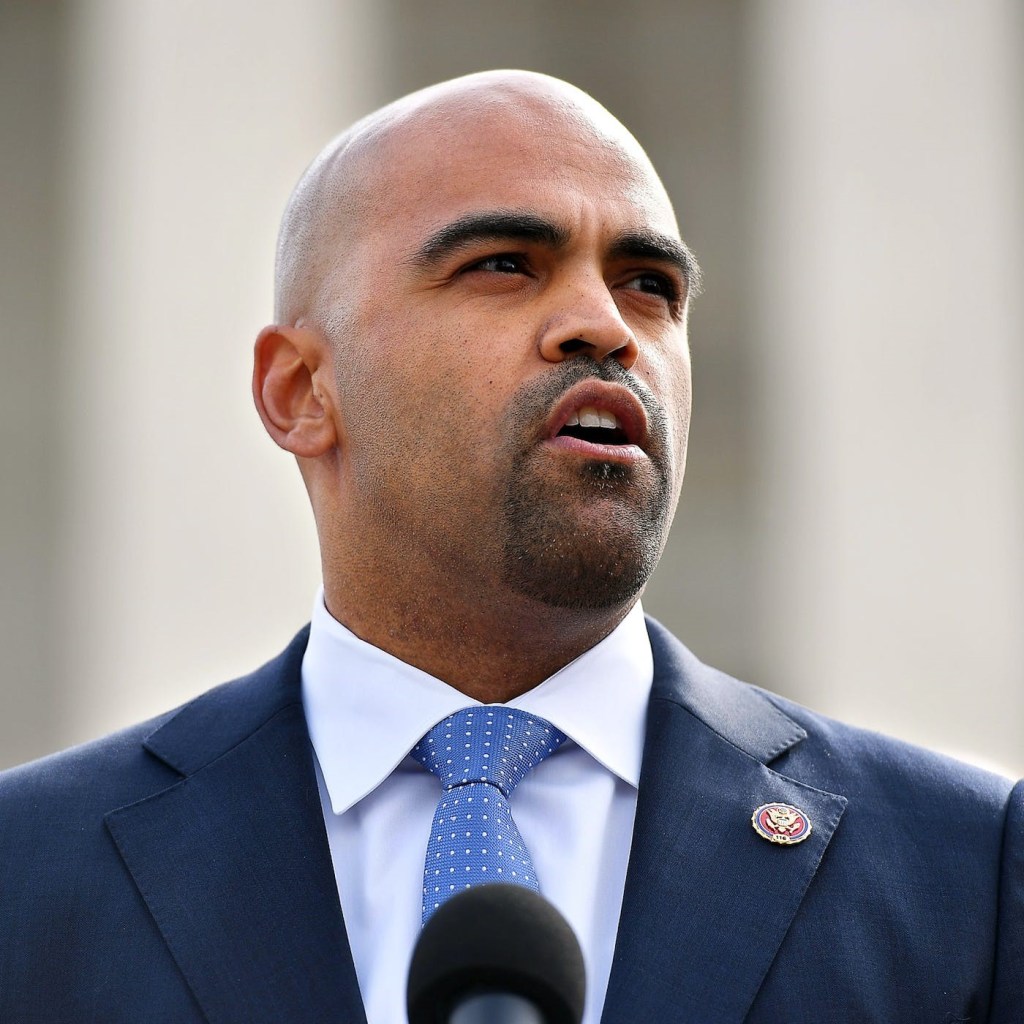
Democratic House Member Colin Allred would be the first black U.S. Senator elected from Texas.
Still, on paper, Cruz and Scott start the election year at least modest favorites to win reelection.
Bottom line: Republicans are poised to do in 2024 what Democrats did in 2022, not lose a single seat they are defending. At best, if Democrats win the national Senate vote by 11 points they could make Florida and Texas highly competitive. If nothing else, Democrats should heavily invest in both states, with their combined 70 electoral votes.
Overall outlook. The bottom line is that, as of January 2024, Democrats – who are defending twice as many seats, 23 (including seven Trump carried at least once) as Republicans (11) – appear almost certain to lose control of the United States Senate. They can afford to lose no more than one seat, and that only if Democrats retain the White House; otherwise, they cannot lose ANY seats.
Democrats are already effectively down one seat – West Virginia – and start as underdogs in Montana and Ohio. The three-way-race in Arizona is very hard to project, with the race essentially a toss-up. That is potentially four Democratic losses, before mentioning the swing-state Senate races in Michigan, Nevada, Pennsylvania and Wisconsin, though Democrats start as favorites in all four.
By contrast, Republicans appear safe in nine of the 11 seats they are defending. Only Florida and Texas, with weak-on-paper incumbents, appear remotely likely to flip. That said, Democrats have potentially strong nominees in these states – especially in Texas – to take advantage of any improvements in the national partisan environment.
Moreover, Republicans appear divided and/or have weak nominees in Montana and Ohio, where Sherrod Brown and Jon Tester have won three consecutive Senate races in increasingly Republican states. And Ruben Gallego is no worse than 50-50 in a possible three-way race in Arizona.
Plus, this all assumes Democrats only win the national Senate vote by a bit over five points, well below the historic three-cycle average of 11 points. If Democrats win nationally by the usual margin, then they are slightly better than even money to retain control. That said, if Democrats only break even in the national Senate vote, losing 6-8 seats is not out of the question.
For now, though, a projected Democratic net loss of 2-4 seats – and thus control of the Senate – is where these elections begin.
Until next time…
[1] With the following weights assigned to each election year: 2022 (3), 2020 (6), 2018 (2), 2016 (5), 2014 (1), 2012 (4). That is, I weight by recency and presidential election year.
[2] Assigned weights: 2022 (4), 2020 (3), 2018 (6), 2016 (2), 2014 (1), 2012 (5)
[3] I used a normal distribution with a mean of 3WRDM-0.6 and a standard deviation of 6.2 to calculate the probability of a Democratic margin of at least 0.0000001. On average in the last three presidential elections, the expected value (3W-RDM plus national margin) has missed by -0.6 points, with a standard deviation of 6.2

 Just Bear With Me...
4 thoughts on “A Somewhat Wicked Early Look at the 2024 US Senate Elections”