
[SPOILER WARNING FOR THE 1995 FILM SE7EN!!]
Thirty years ago, during the first half of 1996, I was a 29-year-old living with his girlfriend in a third-floor corner apartment in Somerville, a short walk from both Davis and Porter Squares. I was either still miserably toiling as an Assistant Registrar at Brandeis University, or I had just been mercifully fired. That I celebrated this act of mercy by crawling inside a bottle of blended Scotch and weeping with extravagant self-pity at music videos recorded on an old VHS cassette is an “undiagnosed mood disorder” story for another time.
My girlfriend – who my wife Nell astutely calls my “first wife” – and I had moved in together in August 1995, two months after I walked away from a doctoral program in government at Harvard ABD – All-But-Dissertation. On the day in question, I was still processing that radical change in my life trajectory, still uncertain where my life was headed as I stared down turning 30 at the end of September.
What made this period of professional limbo tolerable was the patience and love of the woman we now call AC. I describe our relationship here, and how it ended here, but only recently have I begun to sit honestly with the entirety of my 11+ years in Somerville as I mentally map out a book tentatively titled MEET ME AT THE COUNTER: TALES OF AN EARLY GENX IDIOSYNCRAT.
AC and I loved to watch movies together. We soon became semi-regulars at late weekend screenings at the Loews Theatre in Woburn. We also took advantage of a gifted DVD player – complete with a mysterious copy of Blade Runner – to rent films from Blockbuster in Porter Square or West Coast Video in Davis Square.
One weekend night in the first half of 1996, we rented an unusual double feature. To watch these films, we opened out our blue-and-white-striped sleeper sofa, mimicking curling up in bed together. The film we watched first was Chris Noonan’s sweet fantasia Babe. This charming story about a farmer and his newly-acquired sheep-herding pig was fun to watch…and promptly left my head after it ended.
I do not recall why AC went to bed at this point. Maybe it was not a weekend night, and she had to wake early in the morning for her chemistry doctoral program at MIT. Or, she did not want to watch the second film…a little movie about a serial killer following the seven deadly sins that was getting quite the buzz.
I had hesitated to rent Se7en. Psychological crime thrillers were catnip to me, but unfettered brutality and Grand Guignol violence? I had struggled with Pulp Fiction for this same reason, and I loathed the ending of Color of Night. Granted, the latter won the Golden Raspberry for Worst Film of 1994, but for most of its runtime it is a perfectly entertaining thriller that allowed Bruce Willis to practice playing a psychotherapist before crushing it in The Sixth Sense five years later.
Being somewhat emotionally dysregulated, I had difficulty detaching from a kind of visceral over-empathy at depictions of intense, cruel suffering. I also felt physical pain at the sight of bleeding. Nobody was actually bleeding or suffering, but I could not convince my dopamine-starved brain of this. As counterintuitive as that seems.
Like I said, I have spent a lot of time lately trying to sit honestly with this era of my life.
Still, as I sat down to watch director David Fincher’s second feature film, alone in the dark, I was actually OK, despite the oppressive Grand Guignol atmosphere…until we hit sloth. F**k me, what the actual hell did I just see? (If you know, you know.) And that was it for me. I stuck to the end, but I was deeply shaken and psychically scarred.
In short, I absolutely hated Se7en when I first saw it…or so I told myself for more than 20 years.
**********
Flash forward to the spring of 2007. As upset as Fincher had made me 11 years earlier, I very much wanted to see Zodiac in the theatre with Nell. To this point, I had not seen any other Fincher films…no The Game, no Fight Club, no thank you.
Happily, outside of the basement scene between Jake Gyllenhall and Charles Fleischer, this was not the film I had worried I would see. In fact, I thought it was brilliant. The violence was tempered, the acting was masterful, the cinematography was gorgeous. I was also simply a different person at 40 than I was at 29.
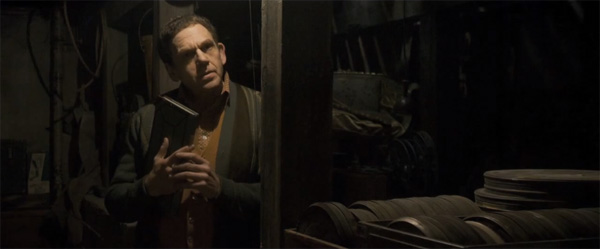
As a student of a certain kind of dark crime film, I was becoming more attuned to the analysis of film as an art, not just as a thing to enjoy for two hours at a time. And folks I respected, including Nell, loved Se7en. In response, I began to adopt a new position – the idea of the film is fascinating, but Fincher went completely overboard with the Grand Guignol aesthetic, ruining a good film in the process.
In November 2016, having just turned 50 and at the end of what I call our annus horribilis in INTEROGATING MEMORY, I broke through my psychic defenses and began to take 37.5 mg of Effexor daily. Four years later, the dosage increased to 75 mg per day, where it remains. If I were a lyric poet, I would compose long odes to the wonders of this medication. Almost immediately, the fog lifted, and I could see things with a bit more emotional distance. I could stop endlessly ruminating on ideas for projects and actually complete them, including launching this website on December 19, 2016.
With my – let’s call it Persistent Depressive Disorder with Atypical Features accompanied by adaptive emotional tamping and hyperintelligence[1] – properly treated for the first time, I was able to enjoy videos on the cinephilic corner of YouTube. Including clicking on ones specifically about Se7en. My resistance continued to break down. When I joined Letterboxd in October 2025, I gave the film 2½ stars, essentially labelling it “good but flawed.” Around that time, I launched a kind of horror film festival after I suddenly wanted to watch Sinister, which softened me even more.
Finally, about a week or two ago, I realized I very much wanted to watch Se7en again. So, I did.
**********
I freely and happily admit I was wrong. Se7en is a spectacular film. The crime scenes are still deeply disturbing, but as I had discovered with Sybil, they were not nearly as grisly or endless as my mind had told me they were. I rewrote my review on Letterboxd, upping my rating to 4½ stars.
As much as I enjoyed this rewatch, however, my analytical mind was trying to make the last third of the film make sense. Two specific questions nagged at me:
- If John Doe’s (Kevin Spacey) hands are covered in Tracy Mills’ (Gwyneth Paltrow) blood when he turns himself in, how could the box containing “her pretty little head” be absolutely pristine later that day?
- Why does someone as scrupulously patient, meticulous and motivated by Catholic dogma as John Doe suddenly panic and decide to murder a pregnant woman not even remotely guilty of a mortal sin?
Yes, I know that the widely-accepted interpretation of the film is that on the final morning of the story, Doe obtains Mills’ home address, gets into the apartment, tries to “play husband” with Tracy, deeply envying her life, fails then kills and decapitates her. He places her bloody head into a cardboard shipping box and arranges to have it delivered at 7 pm that night to a desert location, within a forest of power lines, well outside the unnamed city.
When the box arrives, Detective William Somerset (Morgan Freeman) hesitates, opens the box, recoils in horror then tells the officers hovering overhead in police helicopters, through a hidden microphone, “California, tell your people to stay away. Stay away now, don’t – don’t come in here. Whatever you hear, stay away. John Doe has the upper hand!” Somerset then rushes over to where Detective David Mills (Brad Pitt) has Doe kneeling on the ground at gunpoint. Doe is now monologizing about how much he envied Mills’ “ordinary” happy life with his wife. Mills, overcome with grief and pain – especially having just learned his late wife was pregnant – shoots Doe in the head, killing him.
Having already seen graphic, creative punishments for five deadly sins – Gluttony, Greed, Sloth, Lust and Pride – the easily-anticipated consequences for Mills (Wrath), combined with the death of Doe (Envy), complete the full list of seven.
Oh, and Tracy and her unborn child make eight and nine, depending how you look at it.
Wait, what?
**********
I did not realize until this rewatch that Doe is supposed to be covered in Tracy’s blood when he enters the 14th precinct police station. His hands are so wet, one of the officers restraining him pulls away in disgust. I had assumed, based on the white bandages on each finger and thumb, Doe had sliced off his fingerprints again, getting his own blood all over himself in the process.
But if he is covered in Tracy’s blood, then Doe’s hands had to have been covered in that blood when he put her head in the box. Even if he somehow had time to drain the blood from her head before putting it in the box and/or or wrapped it in plastic to keep blood from seeping through porous cardboard, he still had to touch the outside of the box with his bare hands, leaving bloody handprints all over it.
Gloves or a towel would have removed most of the blood from his hand. They could not have been wet with blood later in the police station. Moreover, Doe could not have used a towel to seal the box and hand it to a courier. Because there is no way a courier is going to enter that apartment to collect a box. He could have used a glove to seal the box and deliver it, but, again, that would have effectively removed the blood from his hands.
There is a related question of timing. Doe has to enter the Mills apartment, subdue and kill Tracy, decapitate her, put her head in the box, seal it, get it to a courier to be delivered that night at 7 pm, then take a cab to the police station to turn himself in.
Except…when Mills and Somerset enter the police station, a desk clerk hands the former a stack of pink phone message slips and says, “Call your wife. Get an answering machine.” The implication is that Tracy has tried to reach her husband multiple times since her husband left that morning. But Doe later says he entered the Mills apartment that morning, after David left for work. She might have called the precinct house once in the morning for some reason, but not multiple times (enough to irritate a desk clerk) – and not with Doe menacing her inside the apartment shortly after her husband left.
The only way to make Tracy calling multiple times make sense is if something were menacing her outside the apartment during the morning. And Doe simply lied about entering the apartment at all.
Now, flash forward an unspecified amount of time. We see the yellow cab pull up across from the 14th precinct station as Mills and Somerset enter. We see Doe’s black-shoed feet alighting, then standing up while the camera points downward, then only his back as he walks across the street. A man walks by him and barely notices him, as you seen in the still below. We never see a drop of blood. We never see his hands or the front of his shirt. Doe does appear to be holding his arms a bit awkwardly, but he could have been doing something with those hands – like cradling something filled with blood.
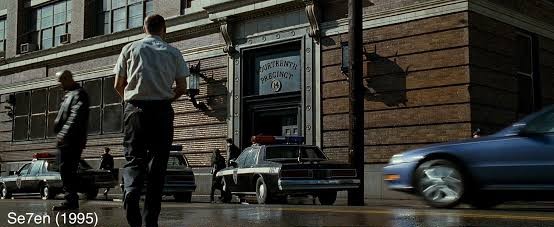
It can be hard to remember that at this point in the film, we have no idea this is John Doe. For all we know, this is a traumatized wrath or envy victim, or an eyewitness.
Now ponder this question. How does a man covered in fresh blood hail and enter a cab, then pay the cab driver at the end of the ride? That money would have been covered in blood, and the cab driver – even in a city as depraved as this one – would have locked the bloody man in his cab and run into the station to tell someone.
We know for an absolute fact that Doe’s hands are drenched in blood when he enters the station. But it is not even remotely feasible they were also covered in blood during the cab ride or while Doe sealed up the box. This can only mean that Doe covered his hands and shirtfront with blood while walking from the cab to the precinct house.
It also means he did not kill Tracy. Nobody did.
**********
From a psychological perspective, Doe killing Tracy makes no sense.
Doe has devoted his entire existence to being an anonymous destroyer of the “deadly sin [we see] on every street corner.” He targets indisputable exemplars of five of these sins – a morbidly obese man, a hypocritical and sleazy defense attorney, a drug-addicted pedophile freed by the same attorney, a woman working in sex club, a supermodel fixated on her appearance – for a highly theatrical demise.
Curiously, Doe does not actually kill these people himself. The attorney cuts out his own flesh, another man serrates the vagina of the woman in the club using a serrated strap-on, and the model swallows the sleeping pills herself. The pedophile is still alive at film’s end, though he is a vegetable. Yes, Doe kicks the obese man in the stomach, effectively killing him, but only after he has been forced to eat spaghetti for more than 10 hours.
These first five victims are what make the last 30 or so minutes of the film feel so off.
Again, the traditional interpretation of Se7en is that the moment Doe comes home with his bags of groceries to find Mills and Somerset outside his front door, he panics, shoots wildly then completely rewrites his death script for wrath and envy. He is suddenly deeply envious of the life David and Tracy lead, so he will now provoke David into becoming wrath – and then David will kill Doe as envy.
And Doe will so provoke Mills…by killing his pregnant wife Tracy?
Before discussing the latter question, let us consider exactly how the hallway scene plays out. Mills and Somerset, armed with an illegally-obtained library checkout list, go to the door of an apartment. They knock on the door. In the background, a man comes out of what we presume is a stairwell. He carries paper grocery bags. He pauses. Somerset notices him standing there, then nudges Mills to look as well. The figure pauses some more. Then, and only then, does the figure drop his bags, pull out a gun and start firing at Mills and Somerset. The chase ensues and Doe corners Mills in the rainy alley, but he does not shoot him.
This is not panic. It is cold calculation.
Doe could easily have turned around before being spotted and walked in a different direction or to a different floor. He could have casually walked to his front door then asked what the two men wanted. (We know he knows who they are from his trick posing as a photographer.) Somerset might have asked him some questions, but without a legal search warrant, he could not enter Doe’s apartment. We know this because he tells Mills exactly this after the chase. Sure, Doe would have shown his face…but so what? A face is just a face until an arrest is made.
Also, if Doe’s intention was to kill Mills and/or Somerset, why not finish the job in the alley? At this point, what does Doe have to lose?
And then comes the kicker. Doe calls his own apartment while it is swarming with police offices. His voice is cool, collected and controlled. This is not a man hiding in panic somewhere. This is a man watching events unfold according to his plan, a man who has been tracking Mills and Somerset for at least a few days.
Speaking of Doe’s plan, it is just not feasible that a man who patiently held a man captive in his own bed for year, spent a weekend locked in with the greedy attorney, spent 10 hours with the gluttony victim (even returning to the store for more spaghetti), arranged for the creation of a very specific instrument of torture and coolly obtained entrance to a model’s apartment to slice off her nose, pivots on a dime to a final, somewhat ludicrous, wrath-envy confrontation in the desert. Then this same man quietly turns himself in, presents his attorney with a carefully-though-out plan, and calmly dunks his tea bag while staring into the one-way mirror?
No. I call total BS on the “panicked pivot” scenario.
Meanwhile, for roughly 90 minutes, Fincher goes out his way to portray Tracy as an innocent recent arrival who has not yet been corrupted by the city. She is a devoted wife and soon-to-be mother. She teaches elementary school. She is generous enough to invite Somerset, who is retiring from the force in a week, to dinner – bypassing her husband entirely – at their new apartment. She confides her worry about living in this city to the same Somerset, recognizing that part of him that is still idealistic and hopeful, the part that quotes Ernest Hemingway and is steeped in classical literature.
Simply put, Tracy did not commit any mortal sin for which Doe can condemn her. She is not gluttonous or greedy, instead sharing what she has with someone she barely knows. She is not slothful, as she actively seeks a teaching job. Any lust she feels is strictly within the confines of a traditional marriage and has led to procreation. Pride? Wrath? Envy? No, no and no. She is self-effacing, kind and seemingly content with her lot in life, even if she in not happy in this particular city at this particular time.
If Doe kills her – and with his own hands, no less – then his entire mission, including the 2,000 handwritten notebooks of 250 pages each, as well as the careful orchestration of five acts of “divinely-inspired” retribution, is the most hypocritical act in film history. It also undercuts the entire film. Doe avers during that ride that the only way to get people to attention is with a sledgehammer. What message do those people receive if you slay someone like Tracy?
We now return to an impossibly pristine box – and Somerset’s reaction to it. If the head had been wrapped in something, Somerset would not have been able to see it clearly, or at all, at a simple glance. Then consider that while is still out of earshot, Somerset does not say something to the effect of “I found our sixth victim. I may need some help identifying it.” Instead, he cryptically talks about Doe having the upper hand and for the cops in the helicopter to stay back.
Now, it is quite possible something resembling Tracy’s head is in the box, made from wax or papier mâché. Given Somerset’s state of mind, and that he expected to find two more bodies, he leapt to the conclusion it was real. No need to look any closer. But…he cannot then confirm to Mills that Tracy’s head is in the box, or he is essentially pulling the trigger himself. Instead, he tries desperately to defuse the situation, to keep Mills calm. Which works until Doe drops the bombshell about Tracy being pregnant.
I think we are supposed to believe Tracy told Doe this while begging for her life. But that right there is the final piece of evidence that Doe never killed Tracy. For while it is just barely plausible Doe would kill Tracy as part of his “master plan,” there is absolutely no way a man suffering from this type of religious mania would kill an unborn child once he learned this.
To me, this is the ultimate proof Doe did not kill Tracy.
**********
If my reading of Se7en is correct, then Doe and Fincher pulled off something extraordinary. They convinced the audience and Mills that Doe killed Tracy, without ever offering any tangible evidence beyond Doe’s “confession” and Somerset’s reaction.
It is so interesting that Fincher spends the first ¾ of the film staging five murder scenes that would make Andre de Lorde himself blanche with horror. He shows us Mills wrestling with his own emotional volatility and the assassination of Doe, albeit from a distance. But he never shows any hint of Tracy’s death. He could have crosscut to cops entering a bloody Mills apartment with the drive to the field. Or show us the bloody head itself, if only for a split second. To me, this restraint is telling. For Se7en to work, we have to see every retributive act – or, at least, its aftermath.
So, what actually happens at the end of Se7en?
The answer lies in the very anonymity Doe achieves. He notes that he is unimportant, that what matters are his actions. We know he begins to plan these actions at least one year earlier, when he designates a man to be sloth. Roughly 51 weeks later, he finds his greed victim, who dies over the weekend, before Doe began to force feed spaghetti to the gluttony victim. He also placed had to have placed the order for the custom-made strap-on sometime before this week. How he selected the man and woman is not known. One day prior to this, and one year from the start of his captivity, the sloth victim is discovered. The model was then the last of these five victims.
Doe mapped all of this out well in advance. He also planned to be killed as the embodiment of envy. He may legitimately have envied folks who did not suffer from cluster headaches and an overwhelming sense of existential horror at the depravity and sin around him. He planned to be killed by a policeman embodying wrath. My hunch is that as he monitored police activity, he immediately recognized the newly-arrived David Mills as the perfect choice. This might explain why he tracked them, and – hypothetically – why he followed Tracy or Somerset to the diner. There, he learned Tracy was pregnant, and he knew he had her husband right where he wanted him.
It is also just possible he followed Mills and Somerset to his own apartment, then grabbed some handy bags to stage his shooting – and provoke Mills even more. He then “spares” Mills in the alley because he needs him for the final act.
Doe also needs a dummy of Tracy’s head. If he can find someone to create a diabolical strap-on – seriously, that is stomach-turningly vile – he can find someone to create a head. Heck, he could swipe a mannequin head and make one himself. He just needs something plausible enough that a preconditioned and hypervigilant Somerset will think it is a genuine human head.
On the morning of the last day, Doe packs up the dummy head, hires the courier with $500 in cash, then goes to the Mills apartment. He does something to alarm Tracy into making multiple phone calls to the 14th precinct, seeking the aid of her husband. He then gathers up some blood – possibly his own, possibly from the model’s face or the lawyer’s body – and takes a cab to the police station. He douses himself in the blood while entering and stages his arrest. His lawyer makes a deal calculated to convince Mills, who just wants him locked up, to travel to the field with Doe and Somerset.
By the time the three men arrive at the field, Mills and Somerset are psychologically conditioned to expect the worst. A package arriving out of nowhere? Is it a bomb, as the men in the helicopter suspect? Or is it one of the two promised victims, as we in the audience assume? All you have to do is consider how many folks insist they saw bloody hair or something equally macabre in the box – when you actually see nothing – to know how easy it would have been to convince Somerset in that exact moment.
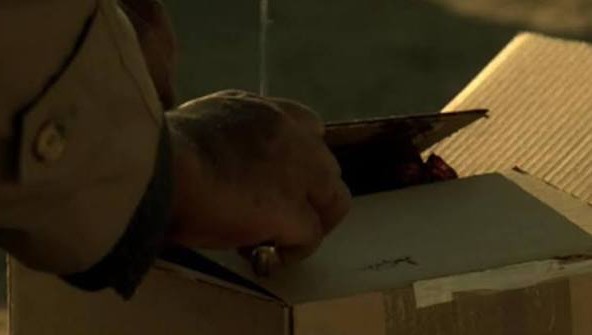
If I am correct about this, Se7en just went from being an amazing film to one of the greatest ever made.
And I am even more glad I gave it a second chance.
Until next time…and if you like what you read here, please consider making a donation. Thank you!
[1] To be very clear, this is not a formal diagnosis made by a trained psychotherapist. This is what I conclude not meeting the criteria for Major Depressive Disorder and my reactivity to positive stimuli. I could get the dopamine hit, but I could not sustain it. As for hypersomnia, overeating, rejection sensitivity and leaden paralysis: kinda maybe sorta, but not really on all of them.


As brilliant as your “Doe didn’t actually kill Tracy” breakdown is, I feel like you’re letting Fincher off the hook… the studio and the censors would never have let them pull a bait-and-switch that subtle without a single visual hint. Still, I respect the hell out of the mental gymnastics it took to get there!
LikeLike
Thank you. Given the conflict over how precisely to end the film, “no blood on the box” may just be a detail that got lost in the shuffle. Plus, this is my reading of the film. Other folks may have a different take, and I love that. Shows what a good film SE7EN is.
LikeLiked by 1 person