
For Parts 1 and 2 of this series, please see here and here.
Just to reiterate, I am not a film critic in the traditional sense, merely an autodidactic lover of film and film history who curated his own, somewhat random, film festival over the first four months of 2025. It began when my wife Nell and I watched Saturday Night (Jason Reitman, 2024), and I watched it again on January 5.
A string of first viewings
As March 2025 neared its end, I had watched 36 films, five of them twice. On average, I was screening a film every other day, then watching whatever high-quality YouTube videos related to that the film I could find. Given that the median release year of these films is 1984 (mean = 1976.4) and only six were released in 2000 or later – only one after 2007 – I think I was ready for more recent titles.
Somehow, I had never seen any films directed by Canadian-born Denis Villeneuve. His January 2025 appearance in the Criterion Closet was the push I needed to watch his 2013 film Enemy. It had been floating on the edge of my consciousness for years, only partly because it stars household favorite Jake Gyllenhall. Doppelgangers are a fascinating and disturbing theme – David Lynch, whose death on January 16 kicked this “film festival” into high gear, is the master of the form – because they prey on our sense of unique identity. This taut, 91-minute film, set in a sickly yellow-and-gray Montreal, did not disappoint. Gyllenhal, in the middle of his golden age, with the deeply unnerving Nightcrawler and a film to which we return coming in 2014, masterfully portrays both an introverted college instructor and an extroverted third-rate actor. Where one man ends and the other begins is still being debated more than a decade later – along with the meaning of all those spiders.
Whether I was now actively searching for interesting new films to watch is difficult to say, I did return to Morgan Richter’s terrific YouTube series When GenX Ruled the Multiplex. I found this series four years ago through her video on Streets of Fire (Walter Hill, 1984). At the time, I had seen just over half (54) of the 100 films she presents, later watching and enjoyed Tuff Turf (Fritz Kiersch, 1985) and Adventures in Babysitting (Chris Columbus, 1987). In March 2025, meanwhile, I was drawn to a trippy and slightly off-putting 1982 film: Liquid Sky, directed by Israeli-born Slava Tsukerman. The trailer was colorful and weird and strangely compelling, so I started to watch it on YouTube. The plot, such as it is, revolves around tiny aliens drawn to early-1980s New York City by their need for the endorphins released in the human brain by heroin. They soon discover that the endorphins released by human orgasm are even stronger – though they kill the just-gratified human in the process. In another form of duality, model Anne Carlisle plays both male and female roles with a kind of slowly-unraveling mania, while Paula E. Sheppard is creepily beautiful as her heroin dealer roommate. The film is colorful enough that it works as a silent film accompanied only by the no-tempo synthesizer score. The opening scenes are so hypnotic, I found myself watching the entire film a second time.

This film led me to watch three very different films on YouTube. The first was Canadian director Michael Snow’s 1967 experiment-in-patience Wavelength. For 45 minutes – shot over a week in a New York City loft – a camera slowly zooms in on what we think is one of the loft’s windows. At times, human beings enter the frame and do things. As noted in the previous two essays, where I discuss the works of Luis Buñuel, Jean Cocteau, Salvador Dali, Maya Deren and Godfrey Regio, I have been drawn to experimental film over the past three or so years. Unlike many people, especially younger viewers, I enjoyed the patience required to learn what Snow wants us to see after 45 minutes. Will I watch Wavelength again? Probably not – though if I did, I would enter it into my Excel workbook of films I have seen multiple times, as it is three minutes longer than Sherlock, Jr. (Buster Keaton, 1924), currently one of my 100 favorite films.
Liquid Sky was indirectly a product of the low-to-no-budget films made in New York City as it suffered through bankruptcy and urban decay in the mid-to-late 1970s. The 2010 documentary Blank City, directed by Celine Danhier, deftly captures this era of “no-wave” cinema during which a wide range of artists could afford to live in a kind of urban playground. Among the stars to emerge from this era were director Jim Jarmusch and actor Steve Buscemi, who worked together in a terrific film I discussed in the previous essay, Mystery Train (1989). While the likes of Amos Poe and Lydia Lunch were filming guerilla-style in New York, usually without permits or much of a script, punk rock and its musical successors were thriving in clubs like CBGB and Max’s Kansas City. The primary overlap between the two worlds was Blondie lead singer and sometime actress Debbie Harry.
Another director to emerge from this “blank city” was Susan Seidelman, best known for her 1985 film Desperately Seeking Susan. By coincidence, this is the first film in Richter’s series. In 1982, she directed Smithereens, which serves as a kind of coda to the era. The last of the four consecutive films I watched on YouTube for the first time follows a young runaway from New Jersey named Wren (Susan Berman) who exists on the fringes of a fading music scene. Richard Hell, leader of punk band The Voidoids, plays Eric, the leader of a never-quite-was band. Wren bounces between him and a young man from Montana named Paul (Brad Rijn) who lives in his broken-down van. Shot wherever Seidelman could run a camera for a time, Smithereens feels a bit like surveying the wreckage of a party all the coolest guests abandoned hours earlier. It is emotionally and visually raw, with some genuinely moving moments. Still, it will likely stay on my “once was enough” list.
Returning to Richter’s selection of 1980s cinema, I decided to watch the long dark night of nuclear paranoia film Miracle Mile (Steve De Jarnatt, 1988) for the first time. I have admired Anthony Edwards since he co-starred in two mid-1980s films that spoke directly to an adolescent on the edge of college: Revenge of the Nerds (Jeff Kanew, 1984) and The Sure Thing (Rob Reiner, 1985). Edwards’ role in Fast Times at Ridgemont High (Amy Heckerling, 1982) – the Greatest High School Film Of All Time – was too small to make an impression at the time. In the compelling near-miss Miracle Mile, Edwards plays trombone player Harry Washello who finds himself in Los Angeles for a few days. Arriving several hours late to the all-night diner, located on the eponymous stretch of Wilshire Boulevard, where he was supposed to meet waitress Julie Peters (Mare Winnigham) for their first date, he answers a ringing pay phone. Thinking Washello is his father, a young man tells him that the Soviets have just launched a nuclear first strike against the United States – giving everyone 50-70 minutes (the number evolves) to react. In essence, Miracle Mile is two films – a breezy romantic comedy and a dark apocalyptic thriller. Edwards hold the two halves together with assured ease. By contrast, Winningham – who married Edwards in 2021 – never quite finds her footing. This is a film with great individual scenes – especially those that take place in and around the diner – I expect to revisit, but maybe not the entire film.

Two threads – Nell and I watching Saturday Night and my rewatch of Wim Wenders’ Wings of Desire (1987) – came together when Nell and I watched Paris, Texas (Wenders, 1984) for the first time. While it is certainly a beautiful film, making exceptional use of green, red, white and blue, I was honestly a bit underwhelmed. The acting – led by quietly-solemn Harry Dean Stanton, patient Dean Stockwell, talented young Hunter Carson and emotionally multi-hued Nastassja Kinski – is marvelous. In fact, Kinski, the daughter of German actor Klaus Kinksi and his wife Brigitte, steals the film in its most memorable scenes, seamlessly expressing a wide range of emotions. Perhaps the ending – even after two hours and 25 minutes – feels too abrupt, the catharsis too muted. Or maybe I was left pondering what could have been had Kinski not returned to Europe after three more unmemorable American films (mean IMDb score = 5.5).
A short string of second (and higher) viewings
When I decided to rewatch Richard Linklater’s stirring Before Sunrise (1995), our older daughter ended her month-plus-long pause on watching films with me – and was glad she did. I had first seen Before Sunrise with the woman Nell calls my first wife when it was released in January 1995. I had not watched it since, though, despite watching Linklater’s Dazed and Confused (1993) and School of Rock (2003) multiple times, and seeing his feature debut Slacker (1990) for the first time earlier in the year. The poignancy of the story – two impossibly-attractive young people, an American (Ethan Hawke) and a Parisian (Julie Delpy), meet on a train in Europe then fall in love during a night spent walking around Vienna, Austria, only to have to part in the morning – may be the reason. Before Sunrise rewarded my 30-year wait. It still felt timeless, the dialogue crisp and natural, the acting almost invisible. Linklater is the master of the “hangout” film, focusing more on relatable characters than the intricacies of plot. Still, I am uncertain about watching the follow-up films Before Sunset (2004) and Before Midnight (2013), as it is the seeming-unlikelines of any future meeting that elevates the original far above the standard “meet-cute.”
I was then amazed by how much I wanted to watch Martin Scorsese’s 1976 masterpiece Taxi Driver for a second time. Despite growing up with this film – it first came to my consciousness when John Hinckley shot President Ronald Reagan in March 1981 – I did not watch it until about eight years ago. Mesmerized as I was by its neon-drenched visuals, Travis Bickle’s (Robert DeNiro) inept interactions with Betsy (Cybil Shepherd) made me so uncomfortable, I expected never to watch the film again. Those neon-drenched visuals proved too compelling, though. I genuinely enjoyed Taxi Driver this second viewing – time and innumerable YouTube videos had eased the discomfort of those interactions, and the rest of the film. I suspect this is a film to which I will return again.
Before returning to a film which genuinely unsettled and disturbed me, here is a kind of lightning round.
In a series of 11 essays I wrote in 2023, I chronicle the doomed romance that followed the end of my relationship with “first wife.” In Part 5, I write: “As I noted above, I had long thought I had not seen SP for four months. But, in thinking about that dreadful weekend – including seeing the execrable Don’t Say a Word at the United Artists Main Street 6, just across the Schuylkill River from my [Philadelphia, PA] apartment…” This was the weekend of October 12-14, 2001. Gary Fleder’s psychological thriller, starring Michael Douglas and Brittany Murphy, had opened nationwide two weeks earlier. More than 20 years later, I recalled thinking it was awful, yet could not remember why it was awful. Watching previews did not help, so one evening I started to watch it on my computer. And I thought, “wait, this isn’t that bad.” The overlong ending gets more than a little silly, but the film is mostly taut, suspenseful and well-acted – especially Sky McCole Bartusiak as Douglas’ kidnapped daughter Jessie.
Two “guilty pleasure” films I had already seen five or more times are Wenders’ first American film, Hammett (1982; produced by Francis Ford Coppola, and featuring a sensational jazz score by John Barry) and Russell Mulcahy’s gorgeous The Shadow (1994). Returning to the comfortably familiar, I rewatched both. Until this viewing, though, I had not made the connection that David Patrick Kelly, who portrays Winston (presumably inspiring Dashiell Hammett to create “Wilmer” for The Maltese Falcon), also plays both psychotic gang leader Luther in The Warriors (Walter Hill, 1979) and Audrey Horne’s uncle Jerry in all three seasons of Twin Peaks. While Hammett still does not get the love it merits, The Shadow is undergoing a slow positive reappraisal.
A final set of first viewings
This brings us to Villeneuve’s 2014 thriller Prisoners, which I watched with our older daughter early in April. Despite knowing it was about a Pennsylvania police detective named Loki (Gyllenhall) searching for two kidnapped girls – not a fun story for a father of two adolescent girls – I was vaguely curious. It proved to be a tightly-scripted, well-acted, beautifully-shot film that tells a compelling story in an interesting way. Upon reflection, though, I had a very different take than most viewers, one I expressed in a 620+-word comment on this video.[1] Simply put, this is not a film about a heroic father of faith doing “whatever it takes” to find his kidnapped daughter. It is about a religious zealot and paranoid survivalist who abuses his family and terrorizes his friends. He also kidnaps and tortures – in nauseatingly graphic ways – a young man with the mentality of a 10-year-old who also survived years of abuse. Dover Keller (a terrifying Hugh Jackman) is MAGA two years before Donald Trump was elected president. As an areligious Jewish-raised atheist, any story that revolves around the loss/redemption of faith is lost on me. There is nothing redeeming about Keller, and I will leave it at that – other than to say that Prisoners evoking such a strong negative reaction suggests it is a good, even great, work of art. Art does not always have to be pleasant to be good.
It was after watching Prisoners that I revisited Don’t Say a Word, Hammett and The Shadow. Needing a change of pace, I returned to the innovative beauty of Eternal Sunshine of the Spotless Mind (Michel Gondry, 2004). To date, this was the only film written and/or directed by Charlie Kaufman I liked: I despised Being John Malkovich (Spike Jonze, 1999), while Synecdoche, NY (Kaufman, 2008) left a bad taste in my mouth.[2] Eternal Sunshine, though, was even better the second time around – yet one more instance of needing to watch a film once for the plot then again for the nuance. Given that my professional brand is “interrogating memory,” I respect the lengths to which Joel Barish (Jim Carrey) fights to keep his memories of Clementine Kruczynski (Kate Winslet) intact. Without painful memories like those, we never learn, and we never grow. Instead, we chase our tails endlessly.
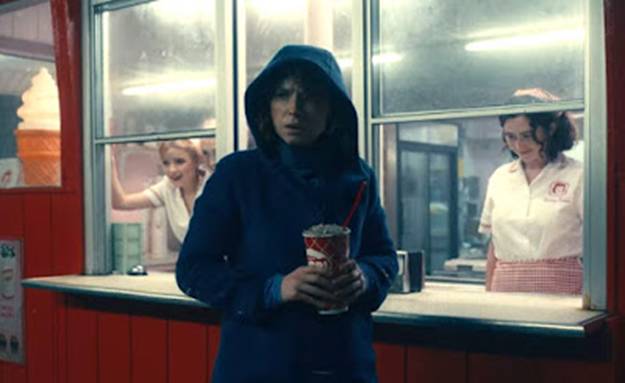
This film led me to previews for a film that I had forgotten had once crossed my curiosity radar: Kaufman’s 2020 Netflix film I’m Thinking of Ending Things (“ITOET”). I was intrigued enough to give Kaufman another chance. Stop me if you’ve heard this one before: halfway through ITOET, I thought to myself “I am not loving this,” only to find myself trying to understand what I had just seen, leading me to rewatch – and love – it. I replayed the scene at Tulsey Town an additional four times – once with Nell – as it is one of the most perfect things I have ever seen on film. Something so bright and inviting amid all of that oppressive darkness – I recall the since-demolished Christie’s Restaurant in Lynn, Massachusetts – is not supposed to be eerie and uncanny. The blue coat worn by the astonishing Jessie Buckley shines amid the predominant white, red and black. As with Prisoners, I have a different interpretation of ITOET than nearly everyone elsse, as I note in a comment on this insightful YouTube video. To say more would spoil this marvelous film – though I am curious to learn your interpretation.
The YouTube video essayist Be Kind Rewind excels at reviewing Academy Award contests. Her take on the Best Actress of 1950 is no exception. Two of the five nominees that year appeared in the same film: All About Eve (Joseph L. Mankiewicz). This renowned film ranked high on my “yet-to-watch” list, so I literally paused the video as she neared the discussion of Anne Baxter and Bette Davis to watch it for the first time. As with Paris, Texas, I was a bit underwhelmed. It is a very good film, to be sure, just not as good as I had been led to believe. Ironically, a film often praised for its sharp dialogue felt overly “talky” to me. The classical acting styles of Davis and George Sanders seemed outdated next to the more subtle emotional shades of Baxter. And I feel no pull from this film – despite memorable turns from a young Marilyn Monroe and the veteran Thelma Ritter, who elevates everything in which she appears. As for the 1950 Best Actress race, I would have voted for Baxter, with Eleanor Parker from Caged (John Cromwell) a close second.
Alan Moore is another author with a mixed cinematic record for me. Watchmen (Zack Snyder, 2009) is a flawed gem I have twice enjoyed, while The League of Extraordinary Gentlemen (Stephen Norrington, 2003) was highly disappointing both times I watched it. I own both graphic novels, which is why I gave League a second chance. I have only watched From Hell (Albert and Allen Hughes, 2001) once, thanks to its unconscionable historical inaccuracies. The film made from Moore’s V For Vendetta (James McTeigue, 2005), meanwhile, did not interest me when it was released, as I was disinclined to visit its tyrannical near-future dystopia. However, the YouTube algorithm started to recommend clips from it to me, which I watched, along with the trailer. No need for a second viewing this time – I loved it from the start. Hugo Weaving is brilliant, despite hiding his face behind a Guy Fawkes mask the entire film. He acts entirely with his body and voice. Natalie Portman’s British accent was slightly off-putting, though she is otherwise excellent. The two Stephens – Fry and Rea – are also terrific as folks who refuse to yield. What truly elevates the film, though, is casting John Hurt, plebeian star of 1984 (Michael Radford, 1984), based on George Orwell’s dystopian novel, as High Chancellor Adam Sutler. One can argue about the necessity of violence in the face of oppression, and whether the philosophy espoused by V is overly simplistic, yet still enjoy this remarkably beautiful film.

Deciding to break Kaufman tie (two likes, two dislikes), I next decided to watch the stop-motion Anomalisa (Duke Johnson, Kaufman; 2015). I understand that to Michael Stone (David Thewlis, who shines as the father in ITOET), who appears to suffer from Fregoli syndrome, everyone else looks and sounds the same. But to have the same man’s voice (Tom Noonan) come out of the mouths of women and children completely took me out of the story. Not that I was enjoying the story very much anyway. At least, not until I heard the voice of my favorite actress, the profoundly-underrated Jennifer Jason Leigh. She gave the film some much-needed light and balance. I will not comment on how deeply uncomfortable the sex scene made me feel. And the bleak ending just left a bad taste in my mouth. Despite loving two of the five films written and/or directed by Kaufman, I still cannot shake the feeling he has all the self-obsession and misery of Woody Allen without any of his leavening wit, humor and insight. It is like staring into a washing machine that never gets any clothes clean. Having said that, I remain curious about the sixth and final Kaufman film, Adaptation (Spike Jonze, 2002).
An unplanned film festival reaches its end
In 2020 and 2021, Nell, our children and I rotated selecting a film for us to watch as a family most Friday nights. One film I chose deeply resonated with our younger child: Cameron Crowe’s semi-autobiographical Almost Famous (2000). I had first seen in it the theater with “first wife” in the fall of 2000. In fact, it was the third-to-last film we saw together – and the last great film.[3] Younger-child loved it so much she periodically asked to rewatch it. On the evening of Saturday, April 26, 2025, meanwhile, she and a friend planned to watch The Texas Chainsaw Massacre (Tobe Hooper, 1974), but mistakenly watched one of the recent remakes instead. When the film ended, the film channel to which the television was tuned was showing Almost Famous. Deciding to watch it a third time, I rented a streaming copy and settled in to watch with younger-child and her friend. Maybe a third of the way into the film, the friend went home. Younger-child and I then thoroughly enjoyed the remainder of this almost-perfect film. The cast – including Billy Crudup, Zooey Deschanel, Philip Seymour Hoffman, Kate Hudson and Frances McDormand – is top-notch, the writing is sharp and tight, and the soundtrack perfectly evokes a nostalgia for rock and roll in the year before punk revitalized the form. Partrick Fugit holds everything together as the wise-yet-innocent William Miller, a stand in for Crowe, who wrote and directed this love letter to his earliest days as a rock journalist. I would be remiss if I did not mention his screenwriting debut was Fast Times at Ridgemont High, starring Jennifer Jason Leigh.
Four months into 2025, I had watched 53 films a total of 60 times – basically a viewing every other day. I watched more than half (28) of these films for the first time, rewatching six – Saturday Night, The Color of Pomegranates, Ivan’s Childhood, Mirror, Liquid Sky, I’m Thinking of Ending Things – almost immediately. The seventh repeat viewing was Inland Empire. Eleven of these first-viewings were directed by someone whose films I had not seen before: Andrei Tarkovsky and Wong Kar-Wai (3 films each), Jim Jarmusch and Denis Villeneuve (2 each), and Terrence Malick (1). Of the remaining 25 films, I watched 14 for the second time, eight for the third time and three for at least a fifth time.
These 53 films cover more than a century (1922 to 2024) and span the globe. Thus, five films were released in 1930 or earlier, while five were released in 2013 or later. More than half (29) were released between 1982 and 2007, while one was released in 1943, two in the 1950s, six in the 1960s and five in the 1970s. The median film was released in 1987 (Wings of Desire). Seven films were in French, meanwhile, while four were in Russian, three were in Chinese (Cantonese), two were in German and one was in Armenian. Three films – Koyaanisqatsi, The Man With a Movie Camera (filmed in what was then the Soviet Union) and Wavelength – had little-to-no dialogue of any kind. Add The Blood of a Poet and L’Age d’Or, and you have five experimental and/or purely surrealist films.
With very few exceptions – He Said, She Said and Where the Truth Lies come to mind – these films are at least somewhat well-regarded. The latter film, Stalker and Anomalisa were the only films I watched for the first time that I genuinely disliked, though Prisoners deeply unsettled me, and I was less impressed by All About Eve and Paris, Texas than I expected to be.
I conclude with a three-film epilogue. Early in May, I rewatched and enjoyed the underrated supernatural thriller Stir of Echoes (David Koepp, 1999), starring fellow Philadelphian and household favorite Kevin Bacon. Then, on the evening of May 16, all four of us sat down to watch The Usual Suspects (Bryan Singer, 1995). This was my fifth time watching this masterpiece of misdirection, pushing it – for now – into my top 10. Younger-child so enjoyed the twist that she asked Nell about films with similarly-mind-bending endings. She mentioned The Sixth Sense (M. Night Shyamalan, 1999), very likely the best film shot and set in Philadelphia. I happily watched it with her for a third time, enjoying seeing a younger Toni Collette, who portrays mothers in this and ITOET. Unlike The Usual Suspects, younger-child did not see the twist coming. In fact, she was badly shaken by it…though this may have been incipient illness.
Until next time…and if you like what you read here, please consider making a donation. Thank you!
[1] Prompting an Internet wit to respond, “Don’t you have a pillow you should be crying into?”
[2] My problem with both films may be the casting of Catherine Keener, who for some reason consistency rubs me the wrong way.
[3] The last two were misfires by acclaimed directors named Robert: Dr. T & the Women (Altman) and The Legend of Bagger Vance (Redford).

 Just Bear With Me...
One thought on “My 2025 Personal Film Festival, Part 3 and Conclusion”