
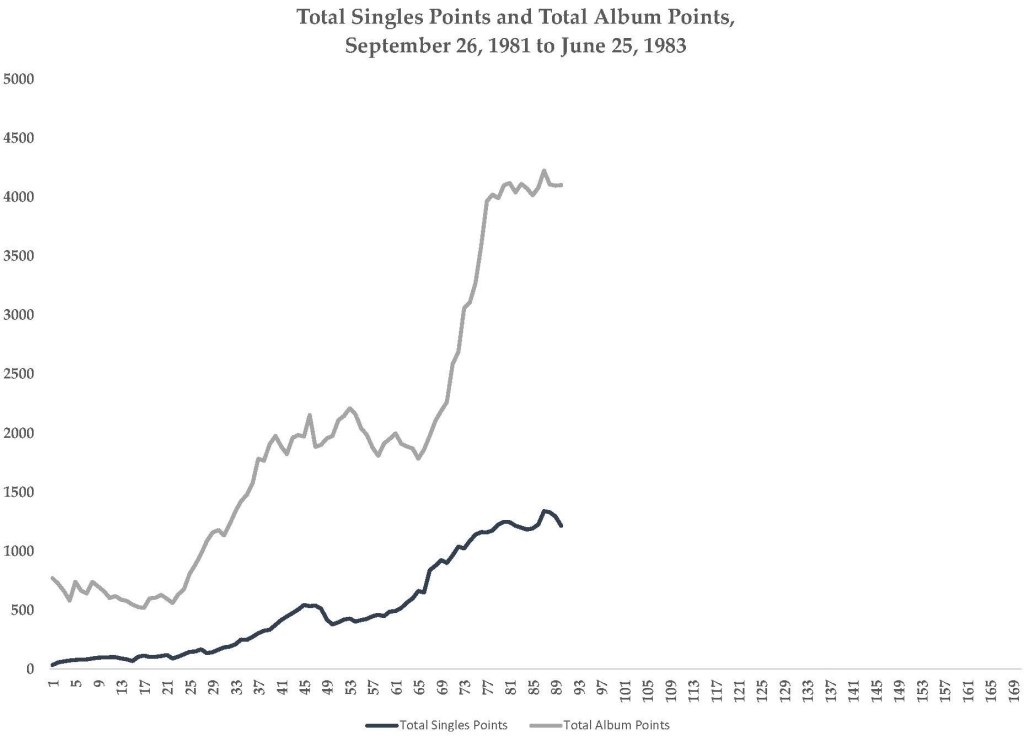
In a previous essay, I used weekly chart positions in the Billboard Hot 100 (singles) and Top 200 (albums) charts to trace the Second British Invasion (“SBI”) from the week of September 26, 1981 through the end of June 1983, just as it reached its first peak. Figure 1 tracks total singles and album points during this time. I used weekly chart positions to calculate points for 171 singles and 186 albums released by a total of 94 unique artists.
Figure 1:
In this essay, I present the second half of this history, concluding with the enormous impact of a collective single released in December 1984.
***********
JULY 1983 TO DECEMBER 1983: THE POLICE RULE THE POP UNIVERSE
Examining the Billboard Hot 100 for the week ending July 2, 1983, we find Eddy Grant’s “Electric Avenue” in its first of five weeks at #2, Culture Club’s “Time (Clock of the Heart)” is #4, having dropped from a two-week peak at #2, and Kajagoogoo’s “Too Shy” is #7, one week away from peaking at #5 for one week. Looking at the rest of the top 20, we find Madness’ “Our House” at #13, Duran Duran’s “Is There Something I Should Know?” at #17 and Naked Eyes’ “Always Something There to Remind Me” at #20. The latter had dropped out of the top 10 one week earlier, after spending two weeks at #8, while the former two reached the top 10 on July 9 and July 16, respectively. Looking at the rest of the top 40, meanwhile, we find Eurythmics’ rapidly-rising “Sweet Dreams (Are Made of This)” at #26; A Flock of Seagulls’ “Wishing (If I Had a Photograph of You)” at #28 (it peaked at #26 the following two weeks); two former top-10 singles – Men At Work’s “Overkill” and Human League’s “(Keep Feeling) Fascination” – at #31 and #32, respectively; and Billy Idol’s “White Wedding (Part 1)” in its first of two weeks peaking at #36. Eight other SBI singles chart between #41 and #100, for a total of 19. Two debuted that week: the anti-nuclear cri de coeur “It’s a Mistake,” the second single from Men At Work’s Cargo, at #42 and the buoyant “I’ll Tumble 4 Ya,” the second single from Culture Club’s Kissing To Be Clever, at #64.
Correction, make that a total of 20. Having entered at #36 four weeks earlier, “Every Breath You Take,” the first single from Synchronicity, The Police’s fifth – and final – studio album, had already climbed to #3; the album debuted at #17 this same week. One week later, the single reached #1, where it remained for eight weeks. The #2 slot was held by “Electric Avenue” and “Sweet Dreams (Are Made of This)” for four weeks each. This was the pinnacle of the Second British Invasion at the very top of the singles chart, as shown in Figures 1 (above) and 2 (below).
Figure 2:
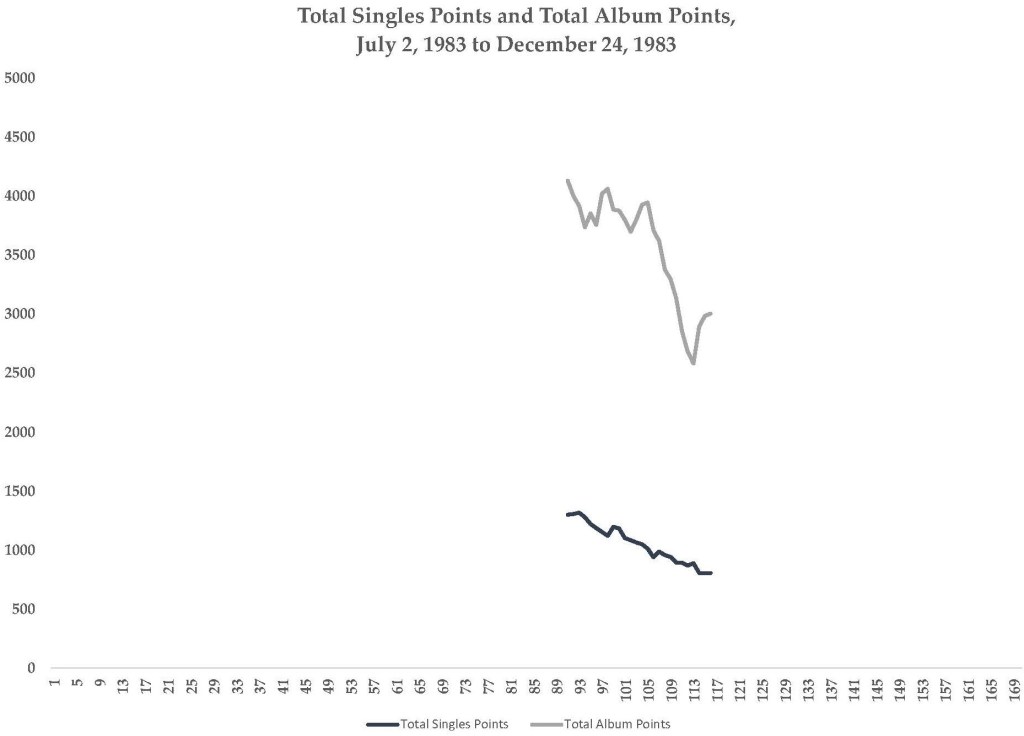
Diminishing returns. The Billboard Top 200 for the week ending July 2, 1983 has Cargo at #4, two weeks after a five-week peak at #3. Grant’s Killer on the Rampage is at #11, where it stayed two weeks before peaking at #10 for three weeks. Culture Club’s Kissing To Be Clever is at #14 for the ninth non-consecutive week, while Thomas Dolby’s The Golden Age of Wireless is at #15, down from its two-week peak at #13. Synchronicity enters at #17, as noted. U2’s War is at #21, A Flock of Seagulls’ Listen is at #22; the former is dropping, the latter still rising – it peaked at #16 for two weeks starting July 16. Men At Work’s Business as Usual is at #28 in its 52nd week on the chart, excluding the repeated week at the end of 1982. A bit further down we see rapidly rising albums: Duran Duran (#35), The Fixx’s Reach the Beach (#39) and Eurythmics’ Sweet Dreams (Are Made of This) (#60). Other albums are rising, but are close to peaking: Kajagoogoo’s White Feathers (#41), Madness (#43), Billy Idol (#47), Tears For Fears’ The Hurting (#75) and Heaven 17’s The Luxury Gap (#89).[1] All told, 34 SBI albums charted this week, 20 in the top 100.
Three weeks later, on July 23, Synchronicity reached #1. It spent 17 non-consecutive weeks there, dropping to #2 for one week on September 10. This began a six-week stretch during which The Police had the #1 single and the #1 album. On August 13, Zenyatta Mondatta and Ghost In the Machine reentered the album chart, followed over the next two weeks by Outlandos D’Amour and Regatta De Blanc. This was the start of a 32-week stretch when all five albums by The Police charted in the United States. It also means that on August 27, 1983, The Police had the number #1 single – with the follow-up “King of Pain” debuting at #37 – and the #1 album, while their entire back catalog charted.
That is pop chart dominance.
In the meantime, Naked Eyes’ follow-up “Promises, Promises” (not a cover of a Dionne Warwick song this time) entered the singles chart at #71 on July 23, along with the second single from INXS’ Shabooh Shoobah, “Don’t Change” (#90). While the former climbed rapidly, the latter – along with Hayzi Fantayzee’s “Shiny Shiny,” Kissing the Pink’s “Maybe This Day” and Tears For Fears’ “Change,” entering between July 23 and August 13 – did not, peaking at #80, #74, #87 and #73, respectively.
The week ending August 27 was the last week “Every Breath You Take” was at #1. At #2 that week was “Sweet Dreams (Are Made of This)” at #2; it rose to #1 for a single week the following week. “It’s a Mistake” was in its second week peaking at #6, while “(Keep Feeling) Fascination,” was in its second week peaking at #8. “I’ll Tumble 4 Ya” was in its first week peaking at #9 for two weeks. At #15, #31, #51 and #98, respectively were “Is There Something I Should Know,” “Electric Avenue,” “Our House,” and “Too Shy;” they had fallen out of the top 10 one-to-six weeks earlier. “Promises, Promises” had risen to #24 – while Spandau Ballet’s “True,” which entered at #67 on August 6, was up to #32. In their second weeks on the chart, meanwhile were Elvis Costello & the Attractions “Everyday I Write the Book” (#71) and Wham!’s “Bad Boys” (#80); the former became Costello’s first American top 40 single on October 15, peaking at #36, while the latter peaked at #60. Debuting that week, finally, were two other follow-ups to top 20 singles: Madness’ “It Must Be Love” at #70 and The Fixx’s “One Thing Leads To Another” at #65. The latter reached the top 40 on September 17, peaking at #33 for two weeks soon afterward. In all, 21 SBI singles charted that week.
However, the next few months saw other SBI artists struggle to replicate top 10 success. Kajagoogoo’s “Hang On Now” peaked at #79 on September 10. One week later, Grant’s “I Don’t Wanna Dance” peaked at #53. The third single from Cargo, “Dr. Heckyll and Mr. Jive” stalled at #28 for two weeks. Eurythmics’ “Love Is a Stranger” and Human League’s “Mirror Man” fared similarly, peaking at #23 (November 12) and #30 (November 19), respectively. However, while Men At Work never reached the American charts again, the latter two artists returned to the top 10 over the next three years.
The Fixx, Spandau Ballet…and reinforcements from Scotland. On August 20, the week Cargo dropped out of the top 10 after 14 weeks, Duran Duran reached #10 for a single week, making Duran Duran the third and final SBI band, after The Police and Men At Work, to have successive top 10 albums AND top 10 singles from multiple albums. That same week, Reach the Beach entered the top 10, where it spent 10 weeks, two at #8. One week later, Sweet Dreams (Are Made of This) hit #15, peaking there for three weeks. On October 1, Elvis Costello & the Attractions’ Punch the Clock, which had entered at #61 on August 13, peaked at #24 for a single week.
Otherwise, there was relative silence on the album chart, as most SBI albums in the top 100 were falling. Albums by Pete Shelley, Fun Boy Three, The Alarm, The Cure, Roman Holliday and Tim Finn (formerly of Split Enz) entered the chart in August and September, with the highest peak #104 for Fun Boy Three’s Waiting. Roman Holliday’s bouncy “Stand By” reached #54 on July 30, with the follow-up “Don’t Try to Stop It” peaking at #68 on October 22. Yazoo’s follow-up You and Me Both hit #69 on September 10, with Graham Parker’s The Real Macaw hitting #59 on October 15 and Wham’s Fantastic! reaching #96 on September 24. Even Joe Jackson’s soundtrack to the film Mike’s Murder peaked at #64 (October 29); “Memphis” topped out at #85 on December 10. Also in October, another dance remix collection (INXS’ Dekadance), plus albums from Minor Detail,[2] Gang of Four, Roman Holliday and The Style Council entered the chart, with the highest peak position #116 for Roman Holliday’s Cookin’ on the Roof.
On October 8, 1983, “Promises, Promises” reached #11, where it spent one week before falling. Two weeks earlier, “Every Breath You Take” fell out of the top 10, followed one week later by “Sweet Dreams (Are Made of This).” That same week, “King of Pain” entered the top 10 at #6, while “True” entered at #7. The latter’s parent album, True, had reentered the chart at #178 on August 27, climbing to #30 by October 8; it peaked at #19 for a single week on October 29. October 8 is also the week “One Thing Leads to Another” entered the top 10, just as “King of Pain” started a two-week run at #3, and “True” started a four-week run at #4. The latter was replaced by “One Thing Leads to Another” for one week – and that is it for the top of the singles chart for SBI artists in October and November 1983.
As with the album charts these same two months, most SBI singles on the Billboard Hot 100 were either falling from their peak or follow-up releases not reaching quite as high as their predecessors (“Dr. Heckyll and Mr. Jive,” “Love Is a Stranger,” “Mirror Man”). Naked Eyes’ third single, “When the Lights Go Out,” entered at #85 on October 22, then peaked at #37 on December 24. Follow-up singles from The Police (“Synchronicity II;” entered November 5, #54), Spandau Ballet (“Gold;” November 19, #68) and The Fixx (“The Sign of Fire;” November 26, #75) “only” reached #16, #29 and #32, respectively.
Thus, as 1983 neared its end, it seemed as though the Second British Invasion was petering out. Except…back on October 1, “Wherever I Lay My Hat Is My Home” by Paul Young entered at #85 – only to peak at #70 four weeks later. One week earlier, meanwhile, The Crossing, the debut album from Scotland’s Big Country, entered the chart at #114. Propelled by a video in heavy rotation on MTV, the rollicking “In a Big Country” entered the singles chart at #73. It only took until December 3 to reach the top 20 – where it peaked at #17 for three weeks. The Crossing had peaked at #18 the first two weeks of November, though it stayed in the top 30 for 12 weeks.
New bands from England and Australia soon followed Big Country, even as two bands once again began to tag-team each other up the singles and album charts, and a former punk lead singer was poised to reach both top 10’s. The Second British Invasion had not petered out – it was simply resting while awaiting reinforcements.
***********
JANUARY 1984 TO DECEMBER 1984: NEXT RELEASES, NEW ARTISTS AND A FINAL SLOW FADE
On November 5, 1983, when it seemed the Second British Invasion was winding down, Colour By Numbers, the second album from Culture Club, entered the chart at #48. The album’s first single, “Church of the Poison Mind,” had entered at #54 two weeks earlier. Not to be outdone, Duran Duran’s third studio album, Seven and the Ragged Tiger, entered at #30 on December 10, with its first single, “Union of the Snake,” entering at #59 on November 5.
By December 3, “Church of the Poison Mind” was at #10, one slot ahead of “Union of the Snake.” The former stalled at #10 for three weeks, while the latter hit #7 on December 10, reaching #3 two weeks later for the first of two weeks (excluding repeated week); it left the top 10 on January 21, 1984. Meanwhile, Colour By Numbers hit #9 on November 25 – the first of 29 consecutive weeks it spent in the top 10, peaking at #2 from February 4 to March 10, 1984. Lagging slightly behind, Seven and the Ragged Tiger hit #10 on January 21, reaching its peak of #8 from February 8 to March 3 and spending 14 non-consecutive weeks in the top 10 overall.
Thus, just as The Police and Men At Work began to exit the SBI stage, Culture Club and Duran Duran took their place, paving the way for the “invasion” to reach its second peak, as shown in Figure 3 below.
Figure 3:

Other new artists follow Big Country. A plausible argument can be made that new singles and albums from Culture Club and Duran Duran reaching the top 10 ended the Second British Invasion – such artists had now fully entered the mainstream.
There is some merit to this argument, especially given the soon-to-follow top-10 success of three other previously-successful SBI artists. However, the stronger counter-argument is that new artists in this vein continued to reach the American charts, demonstrating the ongoing vitality of this pop movement. Some newer artists, like Paul Young and Wham, were initially unsuccessful, even as Big Country soared into the top 20 in just over a month.
On November 12, 1983, meanwhile, the ethereal synthpop single “Send Me an Angel,” from Australia’s Real Life, entered the Billboard Hot 100 at #95. Two weeks later, England’s Re-Flex followed suit when the raucous “The Politics of Dancing” entered at #89. The two singles then climbed the chart in tandem, albeit about a few weeks apart. The former peaked at #29 for two weeks starting February 11, 1984, while the latter peaked at #24 for one week on March 17. Their parent albums entered the Billboard Top 200 one week apart, albeit in reverse order: Re-Flex’s The Politics of Dancing at #188 on December 24, 1983 and Real Life’s Heartland at #195 on January 7, 1984. Each reached the middle of the top 100, peaking at #53 (March 24) and #58 (March 3), respectively.
These new artists were joined by an early pioneer. “Middle of the Road,” the energetic first single from The Pretenders’ third studio album, Learning to Crawl, entered the chart at #50 on December 17, 1983. The album itself entered at #25 on February 4, 1984. Both rose rapidly, though the single stalled at #19 on February 11 and 18. Also on February 11, the last single released by The Police – the shimmering “Wrapped Around Your Finger” – reached #18; it had entered at #61 on January 7. Two weeks later, it reached the top 10, where it spent two weeks, peaking at #8 for a single week.
Back on December 3, 1983, meanwhile, the second single from Colour By Numbers, the hook-laden “Karma Chameleon,” entered the chart at #52. Right on schedule, “New Moon on Monday,” the second single from Seven and the Ragged Tiger, entered at #58 on January 14, 1984. Redefining “rapidly,” the Culture Club single – once again backed by an entertaining video – entered the top 10 on January 14, 1984, just two weeks after “Church of the Poison Mind” fell out. On February 4, “Karma Chameleon” reached #1 for the first of three weeks, making it the 7th SBI single to do so. “New Moon on Monday” took a bit longer, reaching #10 for a single week on March 17.
Not all SBI bands were successfully returning to the upper reaches of the charts, however. U2’s live version of “I Will Follow,” from their live Under a Blood Red Sky album, stalled at #81 for two weeks starting January 28; the album fared better, entering at #68 on December 10, 1983 and peaking at #28 for three weeks; it remained on the Billboard Top 200 for more than a year. One week later, Musical Youth’s Different Style entered at #191, stalling at #144 eight weeks later. The album’s one charting single, “She’s Trouble,” peaked at #65. Over these same two weeks, Adam Ant’s Strip entered at #93, peaking at #65 two weeks later, and ABC’s Beauty Stab entered at #86, peaking at #69 five weeks later.[3] The singles “Strip” and “That Was Then, But This Is Now” peaked at #42 and #89, respectively. Even Big Country’s second single, “Fields of Fire,” only reached #52 (February 25 and March 3).
By contrast, some previously-successful artists were experiencing more success. Billy Idol’s Rebel Yell album entered the chart on December 3, 1983. The first single, the rambunctious “Rebel Yell,” entered the chart at #87 on January 28, 1984. While the latter only peaked at #46 over the last two weeks of March, its mellower follow-up reached the top 10, finally propelling Idol into the album top 10. Eurythmics’ second album, Touch, entered the chart on February 4 – the same week as Learning to Crawl – at #55, reaching the top 10 just seven weeks later (March 24); the latter album entered the top 10 on February 11, peaking at #5 for four weeks beginning on February 25. The first single from Touch, the ethereal “Here Comes the Rain Again,” entered at #53 on January 28; six weeks later, backed by a video that showed just how cinematic the medium had become, it entered the top 10, where it stayed seven weeks, two at #4. And on February 11, “Hold Me Now,” the first single from Thompson Twins’ Into the Gap, entered the chart at #73. It also rose quickly, reaching the top 10 on April 14, peaking at #3 for two weeks starting May 5; the album entered at #98 on March 17, and skyrocketed to #10 in seven weeks; despite dropping out two weeks later, it stayed in the top 30 for 18 weeks.
In the meantime, other new artists experienced at least moderate success. On November 26, 1983, UB40’s album Labour of Love entered the chart at #179. Its first (and only) single, a soft reggae cover of Neil Diamond’s “Red Red Wine” entered the chart at #83 on January 28, 1984 then reached the top 40 on March 17, where it spent two weeks at #34. The album reached #39 on April 14, and again on May 12, as part of its 37-week stay in the top 200. On January 21, Howard Jones’ cheerful synthpop single “New Song” entered the chart at #73. Its parent album, Human’s Lib, did not enter the chart (#167) until March 24, one week before the single peaked at #27 for one week; the album peaked at #59 on June 30 and July 7. This peak coincided with Jones’ second single, the haunting “What Is Love,” which entered at #84 on April 24, reaching #33 for three weeks starting June 9. Another synthpop duo, Wang Chung, saw their single “Don’t Let Go” enter the chart at #89 on February 4; it reached #38 for the first of two weeks just six weeks later. Their debut album Points on a Curve entered at #182 on February 25; it did not gain traction until the release of its second single, “Dance Hall Days,” which entered at #88 on April 21 and peaked at #16 for one week on July 7. One week later, Points On a Curve reached its peak of #30, where it spent three weeks. Young’s “Come Back and Stay” entered the chart at #74 on February 4 and rose quickly, peaking at #22 for one week on April 7; one week later, No Parlez entered the album chart at #180, stalling at #79 eight weeks later, as the follow-up single “Love of the Common People” peaked at #45 on June 30. A boldly-explicit single called “Relax” entered the chart at #84 on April 7, though – during this run – it topped out at #67; we return to Frankie Goes to Hollywood later.
By far the quirkiest part of the Second British Invasion began on March 3, 1984, when a cover of Kirsty MacColl’s “They Don’t Know,” recorded by British actress and comedienne Tracey Ullman, entered at #48. Propelled by an endearing video, the single reached the top 10 seven weeks later, peaking at #8 on April 28 and May 5. Ullman’s album, You Broke My Heart in 17 Places, entered at #93 on March 24, though it stalled at #34 (May 12-19) as the follow-up single “Break-Away” only reached #70 (June 30).
Second and final peak. We quickly pass over albums released in January and February 1984 by Nik Heyward (former Haircut 100 lead singer), Midnight Oil, Echo & the Bunnymen, Malcolm McLaren, XTC and The Cure with a top peak position of #145 (XTC’s Murmur). We also nod only briefly at less-successful follow-up albums which entered the chart on March 17: Thomas Dolby’s The Flat Earth (#96) and Madness’ Keep Moving (#123). The former did reach #35 on April 14 and April 21, though its sole single, the kinetic “Hyperactive,” only reached #62. The latter album topped out at #109 as its sole single, “The Sun and the Rain,” stalled at #72. Modern English’s Ricochet Days peaked at #93 five weeks after entering at #112 on March 24, with its only single, “Hands Across the Sea” only reaching #91 (April 14). Other follow-up albums slightly outpaced their predecessors, as Simple Minds’ Sparkle in the Rain (entered February 18, #154) and The Alarm’s Declaration (March 10, #95) peaked at #64 and #50, respectively, despite no charting singles.
Which brings us to March 3, the day “Miss Me Blind,” the third single from Colour By Numbers, entered at #40. Just four weeks later, it entered the top 10 – peaking at #5 for the first of two weeks on April 21. Thus, on April 21, 1984, “Hold Me Now” (#4), “Miss Me Blind” (#5), “Here Comes the Rain Again” (#9) and “They Don’t Know” (#10) were in the top 10. The Pretenders’ follow-up single “Show Me” was at #29, having entered at #74 on March 17; it peaked for a week at #28 two weeks later. “Come Back and Stay” was at #38, having peaked two weeks earlier. At #40 and #41 were two singles which debuted at #79 and #75, respectively, on March 24: Talk Talk’s hypnotic “It’s My Life,” which peaked at #31 on May 19 and May 26, and Real Life’s follow-up “Catch Me I’m Falling,” which topped out at #40 two weeks later.
A bit further down, at #46, is “The Reflex,” the boisterous third single from Seven and the Ragged Tiger, then the #19 album, behind Synchronicity (#14), Into the Gap (#12), Learning to Crawl (#11), Touch (#7) and Colour by Numbers (#6). And at #60 is “You Can’t Get What You Want (Till You Know What You Want),” the swinging first single from Joe Jackson’s Body and Soul, which entered the album chart at #111 on April 7, the same week as Talk Talk’s It’s My Life (#168) and The Style Council’s My Ever Changing Moods (#190); the latter’s title track entered at #92 the same week, eventually reaching #29 for one week. Peaking at #60, meanwhile, was “Communication,” the third and final single from True. Finally, among the 13 other SBI singles charting that week – out of a total of 25 – were two from new artists: Nik Kershaw’s “Wouldn’t It Be Good” (#63) and Icicle Works “Whisper to a Scream (Birds Fly)” (#85); the former, which had entered at #93 three weeks earlier, topped out at #46, while the latter, debuting this week, reached #37.
“Wrapped Around Your Finger” (#96) was in its 16th and final week on the Billboard Hot 100, making this the last week a new single by The Police charted in the United States. And despite the record-high tying number of charting SBI singles – along with April 23, 1983 – only six were rising in any meaningful way: the songs by Nik Kershaw and Icicle Works plus “The Reflex,” “You Can’t Get What You Want (Till You Know What You Want),” “What Is Love” (#84) and “Dance Hall Days” (#88). Only three of these songs reached the top 20 – and only “The Reflex” reached the top 10, entering on May 26 and peaking at #1 on June 23 and 30. “You Can’t Get What You Want (Till You Know What You Want)” hit #15 for one week on June 23.
We thus sense a movement finally beginning to wind down even as it reaches its second pinnacle. Body and Soul reached #20 on May 26, then spent four weeks there before dropping. One week earlier, Into the Gap fell out of the top 10, leaving Colour By Numbers as the only SBI album in the top 10 for the first time since October 29 to November 19, 1983, when Synchronicity ended its run at #1. Those weeks, the next-highest-charting album was Reach the Beach, dropping from #11 to #15, with Colour By Numbers at #12 on November 19. The albums by Talk Talk, The Style Council, Nik Kershaw (Human Racing) and Icicle Works (Icicle Works) peaked at #42, #56, #70 and #40, respectively. Even Big Country’s Wonderland, which entered the album chart at #189 on May 5, the same week as Human Racing and two weeks after Icicle Works, only reached #65.
An era comes to an end. Perhaps the clearest sign the Second British Invasion was nearing its end came on June 30, 1984, the second and final week “The Reflex” was the #1 single in the United States. Seven weeks earlier, on May 12, “It’s a Miracle,” the fourth and final single from Colour By Numbers, entered the chart at #42, the second only to “Miss Me Blind” for debut position. As was now the norm, the single rose quickly, reaching #20 two weeks later, and #13 three weeks after that (June 16). And then a funny thing happened – “It’s a Miracle” stayed at #13 on June 23, then dropped to #14 on June 30. Six weeks later, it dropped off the chart entirely, having broken a streak of six consecutive American top 10 singles for Culture Club; while two more singles reached the top 20, they never reached the American top 10 again.[4]
Even as Culture Club’s streak came to an end, though, Idol finally cracked the top on both charts. On May 5, the atmospheric “Eyes Without A Face,” the second single from Rebel Yell, entered the singles chart at #63. It reached the top 10 on June 23, peaking at #4 on July 14 and 21. “Eyes” dropped out of the top 10 two weeks later, meaning on August 4, 1984 there was no SBI single in the top 10 of the Billboard Hot 100 for the first time since November 26, 1983, when “Church of the Poison Mind” was #11. The highest-charting SBI singles were “Eyes Without a Face” (#11) and “Doctor! Doctor!” (#14), the second single from Into the Gap, which had peaked at #11 two weeks earlier after entering at #60 on May 26. The third-highest-charting single, at #27, was Eddy Grant’s “Romancing the Stone,” from the movie of the same name; it had peaked at #26 the two previous weeks after debuting at #93 on May 19. The only other SBI single in the top 40 was “The Reflex,” at #35.
Back on July 7, meanwhile, Rebel Yell reached #9 – in its 31st week (as I count them) on the album chart. It spent the next three weeks at #6, dropped to #11, then returned to #10 on August 11. After that, there was no SBI top 10 album until December 8, when Duran Duran’s Arena reached #9, having entered at #49 the week before; its first single, “The Wild Boys,” was at #2 on December 15 and 22.
Only five other albums reached the top 30 during these months:
- The Fixx’s Phantoms hit #30 on September 15, then spent three weeks at #20 and three weeks at #19 between September 29 and November 3.
- Bananarama spent September 29 to October 27 at #30.
- U2’s The Unforgettable Fire hit #29 on October 27, then peaked at #12 from November 24 to December 8.
- Wham!’s Make It Big spent November 27 to December 22 between #25 and #23; it peaked at #1 March 2-16, 1985.
- Culture Club’s Waking Up With the House on Fire hit #30 on November 24, then spent the next four weeks peaking at #26.
These albums were each driven by a key hit single:
- “Are We Ourselves” peaked at #15 for one week on October 20.
- “Cruel Summer” hit #10 on September 22, peaking the following week at #9.
- “(Pride) In the Name of Love” peaked at #33 on December 15.
- “Wake Me Up Before You Go-Go” hit #1 for three weeks on November 17.
- “The War Song” hit #17 for one week on November 17.
Only six other SBI singles reached the American top 40 over the last seven months of 1984: two from Eurythmics (“Who’s That Girl?” #21, June 23-30; “Right By Your Side,” #29, September 8), and one each from Billy Idol (“Flesh For Fantasy,” #29, October 6-13), Naked Eyes (“what (In the Name of Love),” #39, September 19-October 6), Spandau Ballet (“Only When You Leave,” #34, September 15-22) and Wham! (“Careless Whisper,” #37, December 22; it peaked at #1 February 16-March 2, 1985).
A total of 26 other SBI singles – with the highest-peaking Frankie Goes to Hollywood’s “Two Tribes” (#43, December 15) – and 27 other SBI singles – with the highest-peaking Frankie Goes to Hollywood’s Welcome to the Pleasure Dome (#33, December 15-22) charted during this period.
***********
POSTSCRIPT: FAMINE IN ETHIOPIA
On October 23, 1984, the BBC aired a report on the Nine O’Clock News on what Michael Buerk called “a biblical famine, now, in the twentieth century” in Ethiopia. Watching that night was Bob Geldof, lead singer of the Irish post-punk band The Boomtown Rats. Highly successful in their home republic and the United Kingdom, they were little-known in the United States outside of the single “I Don’t Like Mondays,” which peaked at #73 in November 1979; the video for “Up All Night” received airplay on MTV in 1982.
Geldof was so dismayed, he decided to act. Reaching out to fellow musicians, he arranged for some to record a song together. The idea was that this collective, dubbed Band Aid, would use proceeds from the sale of the single to support famine relief. He and Ultravox lead singer Midge Ure cowrote the song, called “Do They Know It’s Christmas.”
On November 25, 1984, a collection of British pop royalty – along with American Kool & the Gang – gathered at Sarm West Studios in London to record the vocal tracks and put the single together. The first voice heard is Paul Young’s. He is followed by Boy George of Culture Club, George Michael of Wham!, Simon LeBon of Duran Duran – who is then joined by Sting, former lead singer of The Police. LeBon and Sting are joined by, first, Tony Hadley of Spandau then Bono of U2. As the chorus swells, they are joined by Paul Weller, formerly of The Jam and currently of The Style Council, Glenn Gregory of Heaven 17 and Ure himself. Playing guitar, at least in the video, are Geldof, Duran Duran’s John Taylor and Spandau Ballet’s Gary Kemp. The members of Bananarama also sang.[5] Holly Johnson, lead singer of Frankie Goes to Hollywood, David Bowie and Paul McCartney sent recorded messages which were incorporated into the single’s B-side “Feed the World.” The single was produced by Ure, with a 12-inch remix later produced by Trevor Horn of The Buggles, Yes and The Art of Noise.
The single was released on December 3. It entered the Billboard Top 100 at #65 on December 22, peaking for a single week at #13 on January 19, 1985 before falling rapidly. It reached #1 in 14 nations, however, plus Europe as a whole, while cracking the top 40 of eight other nations, including the United States.
The ripple effects were extraordinary. In the United States, Harry Belafonte started the process of putting together a collective called U.S.A. For Africa. Lionel Richie and Michael Jackson wrote a single which was produced by Quincy Jones and Michael Omartian. “We Are the World,” featuring a wide array of American pop, rock, soul and country artists, entered the top 100 at #21 on March 23. Three weeks later, it reached #1, where it spent four weeks; it also reached #1 in 16 other nations. Not to be outdone, Steven “Little Stevie” Van Zandt of the E Street Band and producer Arthur Baker put together a mostly-different array of musicians – Artists United Against Apartheid – to record “Sun City,” a protest against apartheid in South Africa. Insufficient radio airplay and, perhaps, “Africa fatigue” led the single to peak at #38 on December 14, 1985 in the United States, though it reached the top 10 elsewhere.
On July 13, meanwhile, London’s Wembley Stadium and Philadelphia’s John F. Kennedy Stadium cohosted an all-day music festival called Live Aid. Organized by Geldof, it featured more than 60 different musical artists – including Queen, in what has been called the greatest live performance ever, and Collins, the only artist to play in both venues – playing for a total of 16 hours; simultaneous performances mean total playing time was just over 24 hours. Relevant to this essay are performances from The Style Council, Adam Ant, The Boomtown Rats, Elvis Costello, Thomas Dolby (playing behind Bowie), Duran Duran, Howard Jones, Nik Kershaw, The Pretenders, Simple Minds, Spandau Ballet, Sting, Thompson Twins, U2, Ultravox, Wham! (George Michael sang with Elton John) and Paul Young.
Earlier that year, finally, Wham! (“Careless Whisper”), Simple Minds (“Don’t You (Forget About Me)”) and Tears For Fears (“Everybody Wants to Rule the World,” with “Shout” following August 3-17) reached #1 on the Billboard Top 100, while Young did so on July 27 with “Everytime You Go Away,” and Duran Duran had just reached #1 with the title song from the James Bond film A View To a Kill.
And if that does not signal the mainstreaming of a once-fringe musical movement, nothing does – meaning, but for some possible final thoughts in a later essay, this is the end of our Billboard-driven tour through the Second British Invasion.
Until next time…if you like what you read on this website, please consider making a donation. Thank you.
[1] They peaked at #38, #41, #45, #73 and #72, respectively.
[2] “Canvas of Life” peaked at #92 on October 1.
[3] The English Beat’s greatest hits compilation What Is Beat? peaked at #87 in its 11th week on March 3, 1983.
[4] One came later that year, while “Move Away” reached #12 in 1986.
[5] As did non-SBI artists like Phil Collins, Status Quo and Jody Watley.

 Just Bear With Me...
One thought on “Charting the Second British Invasion: Overview, Part 2”